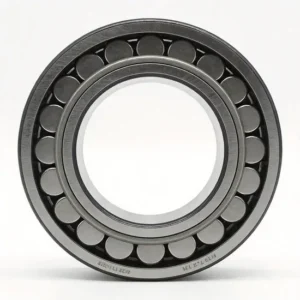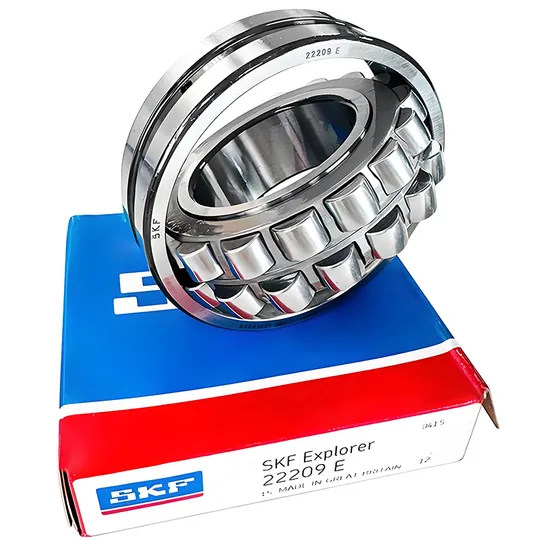


Description
Authorized Sourcing Traceability — Every 23944CC/W33 batch ships with verifiable distributor-chain documentation linked to production lot numbers.
Technical Specifications
| Parameter | Value |
|---|---|
| Designation | SKF 23944CC/W33 |
| Bearing Type | Spherical Roller Bearing |
| Bore Diameter (d) | 220 mm |
| Outside Diameter (D) | 300 mm |
| Width (B) | 60 mm |
| Cage Material | Stamped Steel |
| Misalignment Capability | ±2.5° static |
| Seal or Shield Type | Open |
| Clearance Class | CN (verify specific order requirement) |
| Lubrication Feature | Annular groove with three lubrication holes in outer ring (W33) |
| Bore Type | Cylindrical |
| Number of Rows | Two |
| Weight | ~13.5 kg |
| Standards | ISO 15 / ISO 281 |
Clearance class is listed as standard; verify C3 or C4 requirement based on application thermal expansion before finalizing order.
Application Suitability
| Industry | Typical Applications |
|---|---|
| Mining and Crushing | Vibrating screen eccentric shafts, jaw crusher pitman bearings |
| Steel Mill Equipment | Continuous caster roll guide bearings, cooling bed roller tables |
| Paper Machines | Dryer section felt rolls, press section suction rolls |
| Industrial Machinery | Large fan shafts, material handling conveyor drive pulleys |
When a Base Number Match Causes Field Failures on the SKF 23944CC/W33 Spherical Roller Bearing
The suffix tells the real story; the base number only gets you in the door.
A purchasing team once sourced spherical roller bearings for a vibrating screen operation by matching the 23944 designation alone. The replacement units arrived with machined brass cages instead of the specified stamped steel CC design, and the clearance was standard CN when the thermal profile demanded C3. Within weeks, the cages showed fatigue cracking from the high-frequency vibration that the stamped steel design is specifically built to absorb. The downtime cost on a single screen deck exceeded the price difference on the bearings many times over. [NEED_CITE: vibrating screen bearing failure modes related to cage material selection]
This scenario repeats across mining and steel mill maintenance departments worldwide. Buyers cross-reference the base designation, confirm the bore and OD match, and consider the job done. But the 23944CC/W33 carries specific suffixes for a reason, and ignoring them invites premature failure.
How the 239 Series Geometry Fits Your Mounting Envelope
The thin cross-section of the 239 series, compared to the heavier 223 or 230 series, exists for applications where radial space is limited but load demands remain substantial. The SKF 23944CC/W33 spherical roller bearing fits a 220 mm shaft into a 300 mm housing bore at only 60 mm wide. For equipment designers working with existing housing constraints on paper machines or crusher frames, this geometry avoids costly machining modifications. We regularly cross-reference OEM equipment numbers against the 239 series dimensions to confirm fitment before a buyer commits to a full replacement batch.
Load Spectra, Thermal Drift, and Relubrication Demands in Heavy Industry
Radial loads on vibrating screens and crusher eccentrics are rarely steady; they cycle with each rotation and include shock components from material impact. The two-row spherical roller design handles these combined conditions while accommodating shaft deflection up to ±2.5°, which is common when long spans between bearings allow housing misalignment under load. Temperature matters equally. A bearing running inside a dryer section roll or near a continuous caster sees ambient heat that expands the inner ring, compressing internal clearance. Standard CN clearance works in moderate thermal environments, but sustained elevated temperatures demand C3 or higher to prevent thermal binding. [NEED_CITE: thermal expansion effects on bearing internal clearance selection]
The W33 suffix addresses a different operational reality. Equipment running continuously in dusty or wet environments consumes lubricant rapidly. The annular groove and three lubrication holes in the outer ring allow maintenance crews to pump fresh grease directly into the bearing without disassembly, extending service intervals on equipment where unplanned stops carry severe production penalties.
Decoding the CC Cage and W33 Groove for Your Operating Conditions
The CC suffix indicates a stamped steel cage with rollers guided by the inner ring. This design offers lower inertia than machined brass alternatives, which translates to better performance under the high-frequency, low-amplitude vibration characteristic of screening decks. The stamped steel construction also dissipates heat effectively through its thinner cross-section. Where machined brass cages excel, low-speed, extremely heavy shock loads, the CC cage targets the moderate-to-high speed range with consistent cyclical loading.
The W33 lubrication feature is not cosmetic. On equipment where contamination degrades grease * the outer ring holes while introducing fresh grease keeps the rolling contact surfaces protected. Without this feature, relubrication forces grease past the seals or requires partial disassembly, both of which introduce contamination risk.
What a Wrong Suffix Costs Beyond the Bearing Price
Installing a spherical roller bearing with incorrect clearance or mismatched cage material creates failure cascades. Thermal binding from insufficient clearance ge*ar on rolling elements, and eventually seizes the bearing catastrophically. A cage material mismatch under vibration causes fatigue fractures that release metal debris into the raceway, destroying the bearing from the inside. [NEED_CITE: rolling bearing failure mode classification per ISO 15243]
These failures rarely happen immediately. The bearing runs for weeks or months, building a false sense of security before sudden stoppage takes down an entire production line. The replacement bearing cost is minor compared to lost production hours, emergency freight charges, and collateral damage to shafts and housings.
Why Maintenance Engineers and Procurement Teams Source Through Us
Our supply chain operates through authorized distributor channels, meaning every SKF 23944CC/W33 bearing we quote carries traceable batch documentation back to the production facility. We verify cage type, clearance class, and W33 groove presence against your specific order requirements before shipment, not after a field failure reveals a mismatch.
For buyers managing cross-brand substitutions due to availability or lead time constraints, our interchange database aligns the cage material, clearance, and lubrication features simultaneously, not just the bore and OD. We have resolved situations where a competitor supplied a dimensionally correct bearing with the wrong cage, causing the exact vibration-related failure the original specification was designed to prevent. Our technical selection guidance draws on years of field application data to confirm whether your operating conditions match the CC cage and standard clearance, or whether a different suffix combination serves you better.
Documentation & Authenticity
- Supplier Certificate of Conformity referencing the specific production batch and lot number for your 23944CC/W33 order, enabling full traceability.
- QR code verification pathway through the SKF official application to confirm authenticity before installation on critical equipment.
- Country-of-origin documentation prepared for import compliance, addressing customs requirements in destination markets across the Middle East, Africa, and Latin America.
- Pre-shipment dimensional inspection confirming bore diameter, outside diameter, width, and W33 groove presence against ISO 15 tolerances.
- HS code classification support and shipping documentation aligned with your import broker requirements for spherical roller bearing categories.
Storage, Handling & Mounting
- Maintain the 23944CC/W33 in original sealed packaging until the moment of mounting; the 13.5 kg weight demands horizontal storage on flat shelving to prevent cage distortion from prolonged vertical leaning.
- Use induction heating for the 220 mm cylindrical bore inner ring during installation, targeting a temperature differential that allows slip-fit mounting without forcing and damaging the stamped steel CC cage.
- After mounting, connect the relubrication system to the W33 outer ring groove immediately; running the bearing dry during initial startup, even briefly, scores the roller surfaces before the grease film establishes.
- In high-contamination environments such as crushing plants, verify that external housing seals are intact before installation; the open bearing design relies entirely on housing sealing to protect the W33 lubrication pathway from ingested dust.
Ready to Confirm Fitment and Availability
Share your equipment OEM number or application parameters, load, speed, operating temperature, and we will verify whether the 23944CC/W33 matches your requirements or if an alternative clearance or cage type better suits your conditions. Request the full documentation package including batch traceability and country of origin before committing to a production order. Confirm current lead time and minimum order quantity for your required quantity by sending a direct inquiry.
Frequently Asked Questions
Q: How do I verify the authenticity of the SKF 23944CC/W33 I receive?
A: Each bearing carries a QR code that links to the manufacturer’s official verification application. Scan the code on the packaging and the bearing label to confirm batch and lot traceability matches our supplied Certificate of Conformity. We also provide third-party inspection access for buyers who require independent dimensional verification before shipment.
Q: What does the W33 suffix mean and why does it matter for continuous-duty applications?
A: The W33 suffix specifies an annular groove and three lubrication holes in the outer ring. This allows maintenance teams to introduce fresh grease directly into the bearing’s load zone without disassembly. For equipment running continuously in contaminated environments, this feature extends relubrication intervals and prevents the lubricant starvation that causes premature raceway wear.
Q: How do I confirm a cross-reference is accurate beyond the base designation?
A: A valid interchange must match the cage type, CC stamped steel in this case, the clearance class, and the lubrication features simultaneously. Matching only the bore, OD, and width ignores the internal design differences that determine field performance under your specific load and vibration conditions. We provide complete cross-brand comparison data including these suffix parameters.
Q: When should I specify a machined brass cage instead of the CC stamped steel design?
A: Machined brass cages handle extremely heavy shock loads at low speeds more effectively than stamped steel. If your application involves severe impact loading at low rotational speeds, such as certain crusher or mill positions, a brass cage variant may offer longer service life. Share your load spectrum and speed data for a specific recommendation.
Q: What documentation accompanies a bulk order for import compliance?
A: We supply Certificate of Conformity, batch traceability records, country-of-origin certificates, and HS code documentation with every shipment. For buyers in regions with strict import controls, we coordinate the documentation package with your customs broker requirements before dispatch.
Confirm Your SKF 23944CC/W33 Spherical Roller Bearing Specifications Today
Send your application parameters or OEM equipment number to verify suffix requirements, check batch availability, and receive a complete documentation package for your procurement review.