
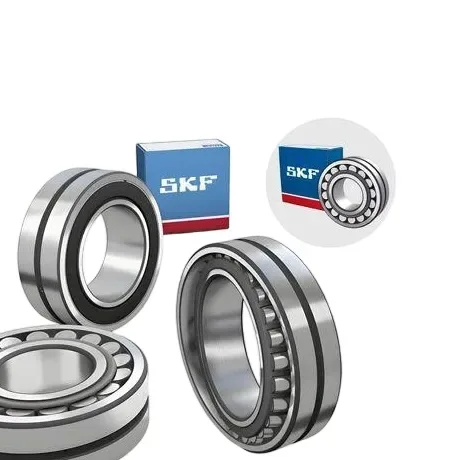


Description
Verified Channel Procurement — every 22212E spherical roller bearing ships with distributor-issued batch documentation and QR traceability for anti-counterfeit verification.
Technical Specifications
| Parameter | Value |
|---|---|
| Designation | 22212E Spherical Roller Bearing |
| Bearing Type | Spherical Roller Bearing |
| Bore Diameter (d) | 60 mm |
| Outside Diameter (D) | 110 mm |
| Width (B) | 28 mm |
| Dynamic Load Rating (C) | 132 kN |
| Static Load Rating (C₀) | 153 kN |
| Limiting Speed | 7,500 r/min |
| Cage Material | Stamped Steel (E suffix) |
| Seal or Shield Type | Open |
| Clearance Class | CN (standard) |
| Precision Class | P0 |
| Bore Type | Cylindrical |
| Number of Rows | Two |
Note: Specific cage design variant and clearance class should be confirmed against the manufacturer catalog before final procurement, as suffix interpretations can differ across brands.
Application Suitability
| Industry | Typical Applications |
|---|---|
| Mining & Quarrying | Vibrating screen exciter mechanism, primary crusher eccentric shaft |
| Steel & Metallurgy | Continuous caster guide rollers, rolling mill table rolls |
| Paper Manufacturing | Paper machine dryer cylinder support, press section rolls |
| General Industrial | Heavy-duty conveyor pulley bearings, bucket elevator drive shafts |
The Cage Suffix Mistake That Shut Down a Screening Line
Matching the base number is never enough — the suffix tells the real story.
On a quarry vibrating screen operating in desert heat, a procurement team sourced 22212 bearings by designation alone. The stamped steel cages in the E-suffix variant were specified for moderate vibration duty, but the actual screening application demanded continuous high-amplitude oscillation. Within weeks, cage pockets showed elongation; within months, cage fracture brought the entire line down for unplanned maintenance. [NEED_CITE: spherical roller bearing cage failure modes under high-vibration duty per ISO 15243] The root cause was not the bearing itself — it was a suffix interpretation error that no one caught during cross-referencing. A significant share of premature field failures in vibrating equipment trace back to exactly this kind of clearance or cage mismatch, not to bearing quality.
Load Spectrum Matching for Vibrating Screen Service
Vibrating screens impose a punishing combination of heavy radial loads, moderate axial thrust from screen deck inclination, and continuous shock pulses from material impact. The 22212E spherical roller bearing addresses this through its two-row barrel roller geometry, which distributes load across a large contact area on the sphered outer raceway. The reinforced internal design indicated by the E suffix increases roller count and optimizes roller-end geometry, yielding higher dynamic load capacity than non-suffixed equivalents. For procurement engineers evaluating replacement bearings, the critical step is confirming that the cage type and clearance class in the cross-reference match the vibration amplitude and operating temperature of the specific screen deck position — not just the bore and OD.
Thermal and Contamination Challenges at the Screen Deck
Vibrating screens in aggregate and mining plants typically run at ambient temperatures that can exceed 45°C in arid regions, with additional frictional heat generated inside the bearing housing. Standard CN clearance may be insufficient when shaft and housing expand at different rates under these combined thermal loads. Lubrication intervals shorten as grease base oil viscosity drops with temperature rise, and the open bearing configuration demands that the housing seals — typically labyrinth or taconite types — carry full responsibility for excluding silica dust and slurry ingress. [NEED_CITE: effect of operating temperature on grease service life in spherical roller bearings] Incorrect re-lubrication intervals or degraded housing seals allow particulate contamination that accelerates raceway spalling far faster than normal fatigue mechanisms.
Decoding the E Suffix and Internal Geometry
The E suffix on the 22212E indicates a reinforced internal design where the manufacturer has optimized roller dimensions and guide flange geometry to maximize load-carrying capacity within the standard 110 mm OD envelope. This design typically features larger rollers or an increased roller count compared to earlier-generation non-E variants, directly improving the dynamic load rating. The stamped steel cage provides adequate guidance for steady-state radial loading but operates within narrower vibration tolerance than a machined brass cage would offer. For vibrating screen exciters where oscillation frequencies and shock loads are continuous, specifying the correct cage material alongside the E suffix is essential. The 28 mm width and 60 mm bore maintain dimensional interchangeability with equivalent designations across SKF, FAG, NTN, and other major manufacturers, but internal geometry differences mean that direct substitution without suffix review risks load capacity gaps.
What a Wrong Bearing Really Costs
A premature bearing failure on a vibrating screen does not end with the replacement part cost. The unplanned downtime cascade includes lost production tonnage, emergency freight for the replacement, potential shaft or housing damage from seizure, and labor for teardown and reinstallation. ISO 281 life calculations assume correct selection of clearance, lubrication, and sealing — when any of these parameters are wrong, calculated L10 life becomes irrelevant and field service intervals collapse unpredictably. [NEED_CITE: relationship between bearing selection errors and unplanned downtime in heavy industry] Counterfeit bearings with soft inner rings and cloned packaging compound this risk further, as they pass visual inspection but fail catastrophically under the shock loads that genuine 22212E spherical roller bearings handle routinely.
How We Reduce Procurement Risk on Every Shipment
Our sourcing model operates through authorized distributor channels rather than single-brand distributorships, which means we can pull 22212E spherical roller bearings from whichever brand has verified stock available while maintaining full chain-of-custody documentation. Every shipment includes batch-level traceability linking back to the manufacturer’s production lot, and we guide buyers through QR code verification using brand official apps where applicable. Our cross-reference database aligns clearance class, cage material, and precision grade across all six major brands — not just the base designation — so that substitution decisions are engineered, not guessed. For import-facing buyers, we prepare country-of-origin certificates and HS code documentation to clear customs without delay. Engineering selection support is available when application parameters fall outside standard catalog conditions.
Documentation & Authenticity
- Supplier Certificate of Conformity tied to the specific 22212E batch and lot number shipped
- QR code verification pathway through the manufacturer’s official authentication app, checked before dispatch
- Material test certificate confirming bearing steel composition and heat treatment condition
- Third-party dimensional inspection report verifying bore, OD, and width against ISO 15 tolerances
- Country-of-origin documentation prepared for import customs clearance in destination markets
- HS code classification support for bearing import declarations
Storage, Handling & Mounting
- Retain original sealed packaging until mounting — the open configuration of the 22212E means any particulate contamination during storage transfers directly to the housing on installation
- Store flat in a dry environment below 60% relative humidity; the stamped steel cage is susceptible to corrosion if condensation forms between the roller pockets
- For cylindrical bore mounting on the 60 mm shaft, use controlled induction heating to 80–110°C rather than mechanical force, preventing cage deformation during press-fit
- Verify residual internal clearance after mounting using feeler gauge through the roller gap — standard CN clearance on the 22212E leaves minimal margin for interference fit reduction
- Confirm housing seal integrity before installation; the open bearing relies entirely on external labyrinth or taconite seals to exclude vibrating screen dust
Start Your Specification Review
Share your vibrating screen model number and operating parameters — vibration amplitude, shaft speed, and housing ambient temperature — so we can confirm the correct clearance and cage combination for your 22212E spherical roller bearing application. If you have an existing OEM equipment number, we will run a full cross-reference check covering suffix alignment across all six brands we source from.
Frequently Asked Questions
Q: What does the E suffix specifically indicate on the 22212E?
A: The E suffix denotes a reinforced internal design with optimized roller geometry and potentially increased roller count, delivering higher dynamic load capacity than non-suffixed 22212 variants. The exact cage material and roller configuration should be verified against the specific manufacturer’s current catalog, as E-suffix conventions can differ between brands.
Q: How do I verify that a 22212E spherical roller bearing is genuine?
A: We supply every bearing with batch-traceable documentation and guide you through the manufacturer’s official QR code verification process. Additionally, we provide material certificates and dimensional inspection reports so you can confirm steel grade and running accuracy independently before installation.
Q: Can I substitute a different brand’s equivalent for the 22212E?
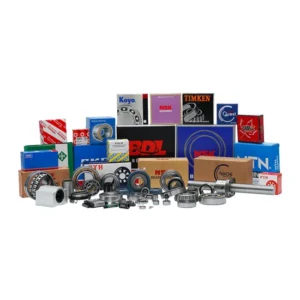
A: Yes, but substitution must cover clearance class, cage material, and precision grade — not just the base 22212 number. Our cross-reference service checks all three parameters across SKF, NSK, FAG, TIMKEN, NTN, and KOYO to ensure the replacement performs identically in your vibrating screen application.
Q: What clearance should I specify for a vibrating screen operating in high ambient temperatures?
A: Standard CN clearance may be insufficient when combined thermal expansion from friction and ambient heat reduces internal clearance below safe operating minimums. C3 clearance is commonly specified for vibrating screens in hot climates, but the correct choice depends on your specific shaft speed, load, and housing temperature — share these parameters and we will confirm the appropriate class.
Q: What documentation ships with a bulk order?
A: Each bulk shipment includes a Certificate of Conformity with batch traceability, material test certificates, dimensional inspection reports, and country-of-origin documentation. For import buyers, we also provide HS code classification and packaging that meets destination customs requirements.
Confirm Your 22212E Specification Before You Buy
Send your application parameters or OEM equipment number, and we will return a complete cross-reference with clearance, cage, and origin verification within one business day.