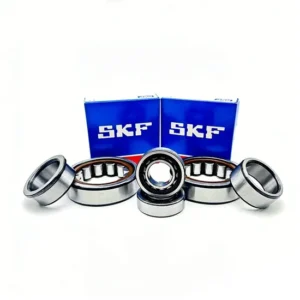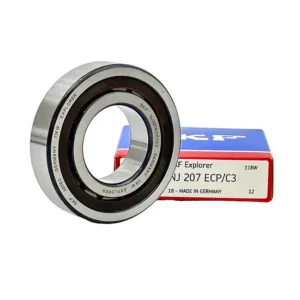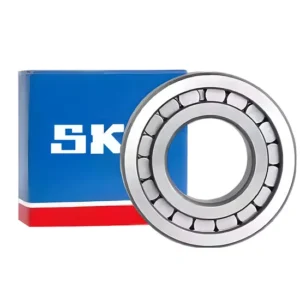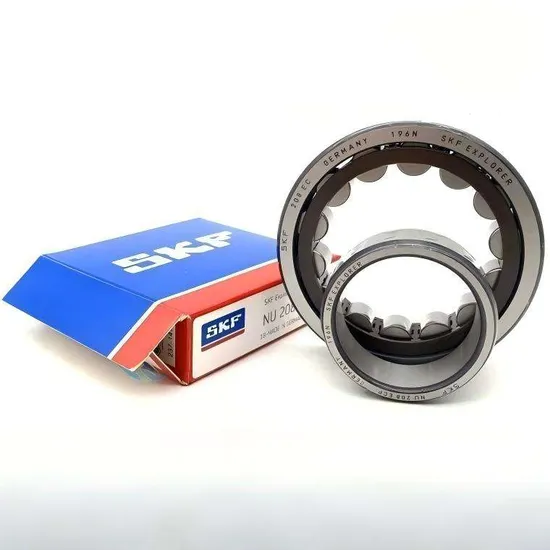
Description
Authorized Channel Sourcing — Every SKF NN3020KTN9/UPVR521 unit we supply ships with Certificate of Conformity traceable to authorized distributor channels, not gray-market resellers.
Technical Specifications
| Parameter | Value |
|---|---|
| Designation | SKF NN3020KTN9/UPVR521 |
| Bearing Type | Double Row Cylindrical Roller Bearing |
| Bore Diameter (d) | 100 mm |
| Number of Rows | Double Row |
| Bore Type | Tapered (1:12 taper) |
| Cage Material | Injection molded glass fiber reinforced polyamide 6,6 (TN9) |
| Seal or Shield Type | Open |
| Precision Class | UP (Ultra Precision) |
| Weight | 0.250 kg |
| Origin | China |
The VR521 suffix designation requires verification against the current SKF catalog for precise internal design or variant details.
Application Suitability
| Industry | Typical Applications |
|---|---|
| Machine tool manufacturing | High-speed spindle radial support, precision grinding wheel spindles |
| Industrial machinery | Precision rotary tables, optical measuring equipment bases |
| Steel and metallurgy | Rolling mill gauge control actuators |
| General MRO | CNC spindle rebuilds, replacement for OEM-specified ultra precision arrangements |
What Happens When Suffix Literacy Fails on Spindle Bearings
The /UP suffix is not interchangeable with P4 — it demands tighter dimensional and running accuracy, and substituting one for the other silently degrades spindle performance.
I worked failure analysis cases where a maintenance team replaced an ultra precision cylindrical roller bearing with what the supplier assured them was "the same thing." The base number matched. The bearing seated fine. But within three months, thermal drift on the spindle exceeded tolerance, and vibration signatures pointed to radial runout well outside the original specification. The replacement wasn’t counterfeit — it was simply a lower precision class dressed in similar packaging. [NEED_CITE: spindle thermal drift caused by precision class substitution in cylindrical roller bearings]
Matching the NN3020KTN9/UPVR521 to Spindle Operating Profiles
The SKF NN3020KTN9/UPVR521 ultra precision double row cylindrical roller bearing addresses a specific intersection of demands: high radial rigidity combined with low friction heat generation at sustained rotational speeds typical of CNC and grinding spindles. Double row cylindrical construction carries pure radial loads while the tapered bore allows precise axial positioning and preload adjustment during mounting. I once supported a Thai tool and die shop converting their lathe spindle from angular contact to a cylindrical roller rear support arrangement — the TN9 cage kept friction temperatures manageable at operating speed, and the UP tolerance class held runout within the grinding envelope they required.
Thermal Loads and Lubrication Demands at Speed
Spindle bearings operate in a narrow thermal window. As rotational speed climbs, polyamide cages like the TN9 generate less friction than brass alternatives, but they also have lower maximum operating temperature limits. The open design here means lubrication is entirely the responsibility of the machine builder or maintenance team — oil-air or oil mist systems are typical for this application class, and the lubricant must reach both roller rows through the cage pockets without pooling. Tapered bore mounting introduces an additional thermal consideration: the interference fit generated by axial drive-up on the tapered shaft seat creates radial expansion that directly affects operating clearance. [NEED_CITE: cylindrical roller bearing preload adjustment via tapered bore axial displacement]
Reading the Critical Suffixes
The UP precision class exceeds standard P4 tolerances in both dimensional and running accuracy, making it suitable for spindles where radial runout directly translates to workpiece surface finish defects. The TN9 cage is glass fiber reinforced polyamide 6,6 — lightweight enough to minimize centrifugal loading on the rollers at high speed, and dimensionally stable under the thermal gradients typical of continuous spindle operation. The K tapered bore with a 1:12 taper ratio is not a convenience feature; it is the primary mechanism for setting internal clearance during installation. Axial displacement on the tapered shaft seat expands the inner ring to achieve the exact operating clearance the spindle design requires. The NN double row configuration provides the radial stiffness needed to resist cutting forces without deflection.
What a Wrong Bearing Actually Costs the Shop Floor
Correct selection backed by traceable sourcing protects the spindle and the work it produces. The alternative is harder to quantify until it shows up as scrap. A precision class mismatch may not cause immediate seizure — instead it erodes surface finish quality over weeks, generating reject parts that nobody traces back to the bearing. A counterfeit with a soft inner ring might pass initial runout checks but loses dimensional accuracy as the raceway deforms under cyclic loading. ISO 15243 classifies these degradation patterns distinctly, yet most shops see only "spindle problems" on the maintenance ticket. [NEED_CITE: ISO 15243 bearing failure mode classification for cylindrical roller bearings]
How We Reduce Sourcing Risk for This Bearing
Our procurement chain runs through authorized distributor channels, meaning the SKF NN3020KTN9/UPVR521 units we deliver carry documentation traceable back to the manufacturer’s distribution network. Each shipment includes batch-level traceability so you can verify the production lot through the SKF official app. When a customer needs cross-reference validation — perhaps substituting this bearing into equipment originally specified with an NSK or FAG equivalent — we verify not just the base designation but also the cage material, precision class, and clearance together, because matching only the bore and OD is how spindle failures start. We also provide country-of-origin documentation and HS code support so import paperwork doesn’t delay customs clearance at your port.
Documentation & Authenticity
- Supplier Certificate of Conformity with batch and lot traceability specific to the SKF NN3020KTN9/UPVR521 shipment
- Third-party runout inspection report confirming UP-class running accuracy prior to dispatch
- SKF official app QR code verification pathway for authenticity confirmation at the receiving dock
- Material certificate documenting bearing steel grade and heat treatment compliance
- Country-of-origin certificate and HS code documentation for import customs processing
Storage, Handling & Mounting
- Retain the original sealed packaging until the moment of spindle assembly; the UP precision class surfaces are vulnerable to dust and moisture contamination during storage
- Handle the bearing with clean lint-free gloves — fingerprint acidity on the exposed raceways of this open-type bearing can initiate corrosion within days in humid environments
- During tapered bore mounting, measure axial drive-up distance carefully against the spindle manufacturer’s specification to achieve correct internal clearance expansion on the 1:12 taper seat
- Use only induction heating methods for the inner ring if thermal mounting is required; never apply open flame, as uneven heating distorts the UP-class raceway geometry
- For matched spindle sets, keep factory pairing marks aligned during installation; disturbing the arrangement order defeats the precision matching done at the factory
Starting the Conversation
Share your spindle operating parameters — speed range, radial load profile, lubrication method, and required runout tolerance — so we can confirm whether the SKF NN3020KTN9/UPVR521 ultra precision double row cylindrical roller bearing fits your application without qualification. If you are replacing an existing bearing, provide the OEM equipment number or the full designation from the nameplate, and we will cross-verify the precision class, cage type, and bore configuration before quoting.
Frequently Asked Questions
Q: How do I verify that a received SKF NN3020KTN9/UPVR521 is genuine and not a cloned-QR counterfeit?
A: Scan the QR code on the packaging using the SKF official app — genuine products link to batch traceability records that match the physical marking on the bearing itself. We also supply a Certificate of Conformity tied to the specific lot number shipped.
Q: What does the UP precision class mean, and how does it differ from P4 or P4A?
A: UP (Ultra Precision) represents tighter dimensional and running accuracy tolerances than standard P4. It is specified for applications like machine tool spindles where minimal radial runout directly affects workpiece quality.
Q: Why must I match the cage material during cross-reference substitution, not just the base number?
A: A brass cage (M) and a polyamide cage (TN9) have different maximum speed capabilities, thermal characteristics, and lubrication compatibility. Substituting one for the other in a high-speed spindle can cause premature cage wear or thermal instability.
Q: How does the K tapered bore affect installation procedure compared to a straight bore?
A: The 1:12 tapered bore requires axial displacement on the shaft seat to set internal clearance. This drive-up distance must be calculated or specified by the equipment designer — under-driving leaves excessive clearance and vibration; over-driving creates preload that generates heat and shortens bearing life.
Q: Can I get documentation supporting country of origin for customs and import compliance?
A: Yes. We provide country-of-origin certification and HS code documentation with every shipment, which is particularly important for buyers in regions where bearing import documentation requirements are strict.
Confirm Your Spindle Requirements
Send us your operating parameters or OEM equipment number, and we will verify application fit and confirm batch availability.
[NEED_CITE: authorized bearing distributor traceability documentation standards]