



Description
Authorized Channel Sourcing — Every INA GE50-DO spherical plain bearing ships with batch-level traceability back to the manufacturer’s production run, supported by Certificate of Conformity and dimensional verification documentation.
Technical Specifications
| Parameter | Value |
|---|---|
| Designation | INA GE50-DO |
| Bearing Type | Spherical Plain Bearing |
| Bore Diameter (d) | 50 mm |
| Ball Diameter | 66 mm |
| Weight | 0.540 kg |
| Ball Material | Bearing Steel (Steel-on-Steel) |
| Precision Class | P2 |
| Lubrication | Maintenance type with lubrication access |
| Origin | China |
The "DO" suffix remains unverified against the current INA catalog and should be confirmed with manufacturer documentation before finalizing application-critical orders.
Application Suitability
| Industry | Typical Applications |
|---|---|
| Mining and Crushing | Crusher toggle plate pivots, vibrating screen eccentric shafts |
| Hydraulic Cylinders | Cylinder clevis joints, rod-end articulation points |
| Agricultural Machinery | Tractor linkage pivots, harvester header tilt joints |
| Material Handling | Conveyor transfer point actuators, stacker/reclaimer slew joints |
What a Liner Misread Costs on a 50 mm Pivot
Steel-on-steel is the only contact surface that survives heavy oscillating loads without liner debris contamination.
A crusher operation in South America once specified a PTFE-lined spherical plain bearing for a 50 mm pivot carrying heavy oscillating radial loads. The liner shredded within weeks, the joint seized, and the resulting unplanned downtime far exceeded the replacement part cost. The base designation looked correct on paper — bore size matched, OD matched — but the sliding contact surface was wrong for the load spectrum. That mismatch between base number and actual contact surface design is where field failures start. [NEED_CITE: spherical plain bearing failure modes under heavy oscillating loads per ISO 15243]
Where the INA GE50-DO Earns Its Keep
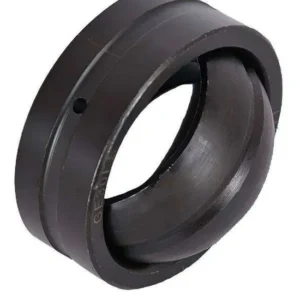
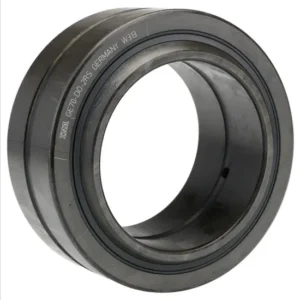
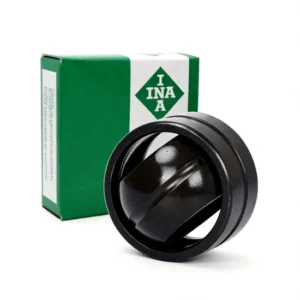
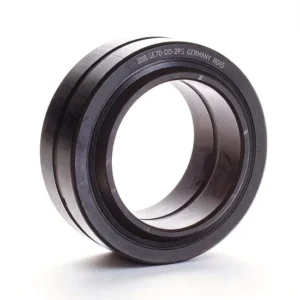
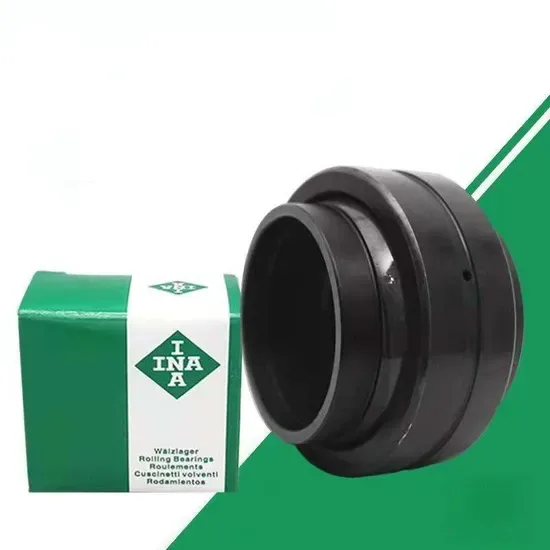
This INA GE50-DO spherical plain bearing fits applications where articulating joints face sustained radial loads with slow oscillation rather than continuous rotation. The steel-on-steel sliding contact handles shock loads that would destroy polymer-lined alternatives, while the integrated lubrication access holes let maintenance crews re-grease on schedule without disassembly. I’ve seen these hold up in hydraulic cylinder clevis joints on excavators running 16-hour shifts in abrasive dust — provided the re-lubrication interval is actually respected.
Loads, Oscillation, and the Grease Interval That Gets Ignored
The load profile here is predominantly radial with occasional axial components from misalignment, and the motion is oscillating rather than continuous rotation. That means lubricant film thickness depends entirely on re-greasing discipline — there is no hydrodynamic wedge building up at low oscillation speeds. Temperature swings in outdoor mining or agricultural environments affect grease viscosity and can accelerate bleed-out, shortening effective service intervals. The maintenance-type design with lubrication access holes exists precisely because these joints cannot rely on sealed-for-life lubrication. Ignoring the re-greasing schedule on a steel-on-steel contact surface turns a multi-year component into a multi-week one. [NEED_CITE: lubrication interval impact on spherical plain bearing service life]
Decoding the Core Specifications
The 50 mm bore diameter and 66 mm ball diameter create a load distribution zone suited for the moderate-to-heavy radial loads typical in articulating joints. Steel-on-steel sliding contact means both inner and outer rings are hardened bearing steel — no polymer liner to delaminate under shock loading, but also no self-lubricating property, which is why the lubrication access holes are non-negotiable. The P2 precision class represents tight dimensional tolerances, ensuring the ball-to-socket fit minimizes internal clearance and prevents the micro-movement that accelerates fretting corrosion. At 0.540 kg, the mass is consistent with a standard-duty radial spherical plain bearing in this size range — nothing oversized, nothing cut thin.
The Price Tag Hidden Inside a Wrong Suffix
Ordering a spherical plain bearing by base number alone and ignoring the contact surface suffix is how maintenance budgets bleed money. A maintenance-required steel-on-steel unit installed where a maintenance-free PTFE-lined type was specified will fail prematurely if no re-greasing program exists. Conversely, putting a PTFE-lined bearing under heavy shock loads that demand steel-on-steel contact leads to liner destruction and seizure. Either error triggers unplanned downtime, emergency freight charges for replacements, and potential collateral damage to adjacent shafts and housings. [NEED_CITE: rolling bearing failure mode classification per ISO 15243]
How We Keep Your Supply Chain Honest
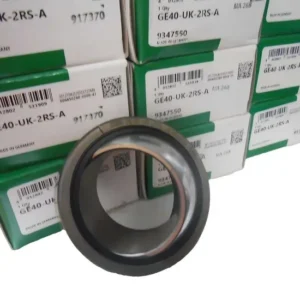
We source INA spherical plain bearings through authorized distributor channels with full batch and lot traceability — not from unverified trading desks. Every GE50-DO shipment includes a Certificate of Conformity tied to the production batch, and we provide QR code verification pathways through brand official apps so you can confirm authenticity on receipt. Our cross-reference database matches not just the base designation but also the contact surface type, clearance, and lubrication design — so when you need to interchange between brands, the replacement actually survives in the field. Country-of-origin documentation comes standard for your import compliance paperwork, and dimensional inspection reports accompany each shipment so you can verify before installation.
Documentation & Authenticity
- Supplier Certificate of Conformity tied to the specific production batch of your INA GE50-DO order
- Third-party dimensional inspection report verifying bore, ball diameter, and running accuracy before dispatch
- QR code verification pathway through brand official apps for on-receipt authenticity confirmation
- Country-of-origin documentation supporting import compliance and customs clearance
- Material certificate confirming bearing steel composition for the steel-on-steel sliding contact surfaces
Storage, Handling & Mounting
- Keep the INA GE50-DO in its original sealed packaging until the moment of installation; the steel-on-steel contact surfaces are vulnerable to moisture-induced fretting corrosion once the factory preservative is disturbed
- Store below 30°C in a dry environment with humidity controlled below 60% to protect the exposed bearing steel surfaces from condensation damage
- Use clean lint-free gloves when handling the 50 mm bore and 66 mm ball surfaces — skin oils on steel-on-steel contact zones accelerate corrosion onset
- During mounting, use induction heating for the outer ring if an interference fit is required; avoid direct flame on the ball surface to prevent localized hardness loss
- Connect the grease supply to the lubrication access holes immediately after installation and purge until fresh grease appears at the joint gap, confirming the steel-on-steel interface is fully coated before first articulation
Request a Technical Review
Share your application parameters — load magnitude, oscillation frequency, ambient temperature range, and re-greasing capability — so we can confirm whether the INA GE50-DO steel-on-steel design matches your duty cycle. If you’re replacing an existing bearing, provide the OEM equipment number or current designation for a complete cross-reference check including contact surface and lubrication type alignment.
Frequently Asked Questions
Q: How can I verify the authenticity of an INA spherical plain bearing before installation?
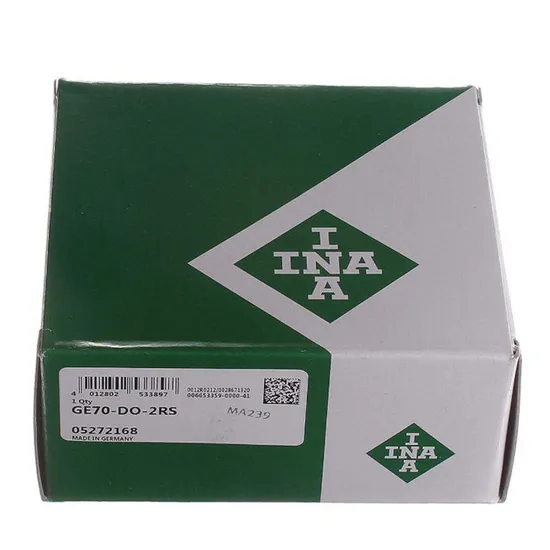
A: Use the brand’s official verification app to scan the QR code or batch marking on the packaging and bearing itself. We supply a Certificate of Conformity with batch and lot traceability so you can cross-check against manufacturer records. Any discrepancy in markings, surface finish, or dimensional values should trigger a hold before installation.
Q: What does the GE prefix indicate in INA spherical plain bearing designations?
A: The GE prefix identifies a steel-on-steel sliding contact surface design, meaning both the inner ring ball and outer ring bore are hardened bearing steel without polymer liners. This configuration handles heavy radial and shock loads but requires periodic re-lubrication through the integrated grease access holes.
Q: How do steel-on-steel and PTFE-lined spherical plain bearings differ in application?
A: Steel-on-steel designs like the GE50-DO tolerate heavy shock loads and high static pressures but depend on scheduled re-greasing. PTFE-lined types offer maintenance-free operation under lighter, more consistent loads but will suffer liner damage under heavy shock or contaminated environments. Selecting the wrong contact surface type is a common cause of premature joint failure.
Q: What re-lubrication practices apply to maintenance-type spherical plain bearings?
A: Re-grease through the lubrication access holes at intervals determined by load, oscillation frequency, temperature, and contamination level. Purge until fresh grease is visible at the joint seal gap. In dusty or wet environments, shorten the interval significantly. Use a lithium-complex or compatible grease recommended for sliding contact surfaces.
Q: What import documentation is available for bearing procurement?
A: We provide country-of-origin certificates, HS code classification support, and Certificates of Conformity suitable for customs clearance in most jurisdictions. Batch traceability documentation is included with every shipment for quality audit requirements.
Confirm Your INA GE50-DO Requirement
Send us your application parameters or OEM equipment number for a cross-reference review and availability check. Our technical team will verify contact surface compatibility and lubrication design match before quoting.