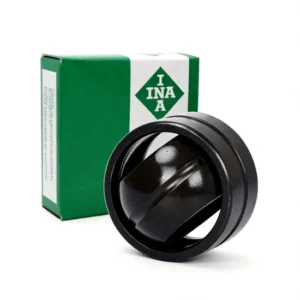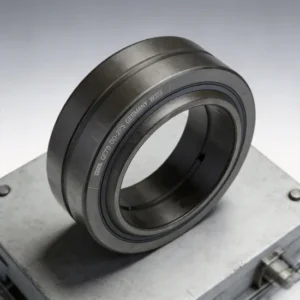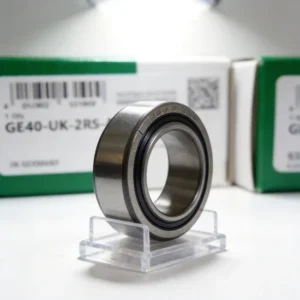
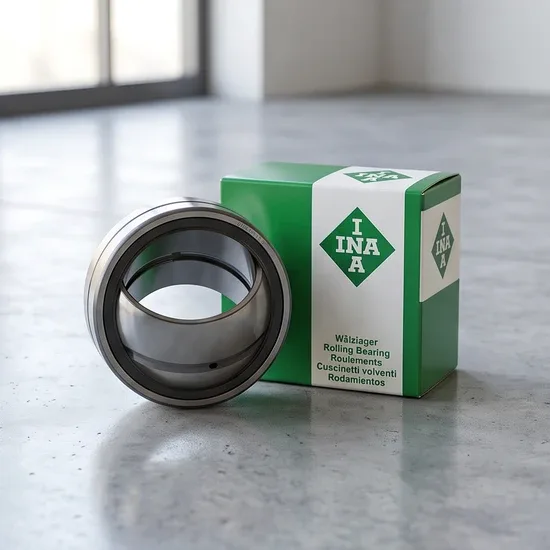


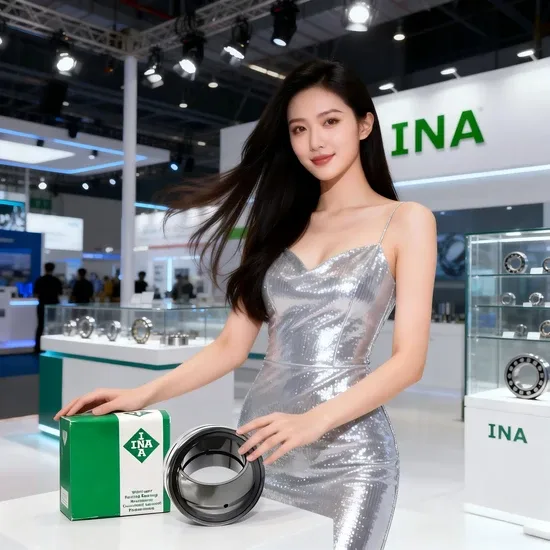

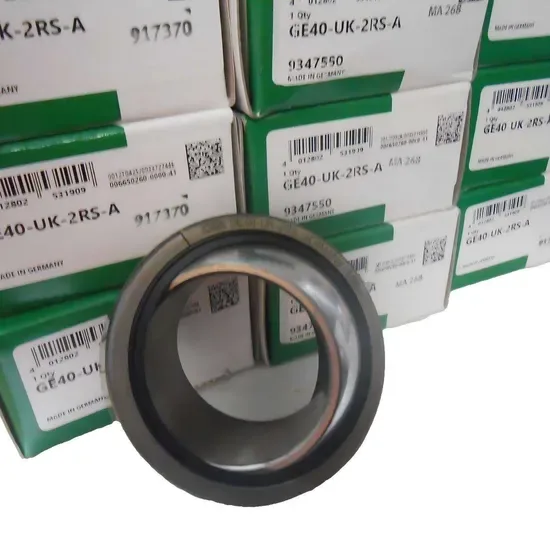
Description
Authorized Channel Sourcing — Every GEUK20ES, GEUK25ES, and GEUK30ES ships with full batch traceability back to the PTFE liner production run and steel backing heat lot.
Technical Specifications
| Parameter | Value |
|---|---|
| Designation | INA GEUK20ES / GEUK25ES / GEUK30ES |
| Bearing Type | Spherical Plain Bearing |
| Liner Material | PTFE Composite |
| Base Material | Steel + PTFE |
| Lubrication | Maintenance-Free / No Lubrication Required |
| Origin | China |
Suffix note: The "U", "K", and "ES" suffixes in this series require confirmation against the manufacturer’s current catalog for full dimensional and treatment specifications.
Application Suitability
| Industry | Typical Applications |
|---|---|
| Industrial Machinery | Articulating link arms in automated assembly stations |
| Material Handling | Pivot joints on conveyor diverter gates |
| Automation Equipment | Oscillating wrist joints on articulated robotic arms |
| General MRO | Replacement pins and clevis joints on hydraulic cylinder rod ends |
What Happens When a PTFE Liner Fails Mid-Cycle on an Automation Joint
A contaminated or worn liner turns a maintenance-free joint into an unplanned line stoppage within hours.
Most maintenance engineers assume that once a spherical plain bearing is specified as maintenance-free, the sliding surface will outlast the machine it sits in. In reality, a significant share of premature failures in automation joints trace back to liner degradation caused by particulate ingress or substitution of a relubricatable design where a dry-running PTFE surface was required [NEED_CITE: plain bearing failure modes in oscillating applications]. When the liner wears through, steel-on-steel contact generates debris that migrates into adjacent seals and guideways, compounding damage well beyond the joint itself. The GEUK20ES GEUK25ES GEUK30ES maintenance-free PTFE spherical plain bearing series was designed to remove the lubrication variable entirely from these failure chains.
Matching the Liner to the Load Spectrum in Articulating Joints
Oscillating joints in automation equipment rarely see continuous rotation. Instead, they endure short-angle oscillations under combined radial and axial loads, often reversing direction dozens of times per minute. The steel backing on the GEUK series carries the static and shock loads, while the PTFE composite liner manages the sliding friction at the contact interface. This division of function is precisely what makes the GEUK20ES GEUK25ES GEUK30ES maintenance-free PTFE spherical plain bearing suitable for clean environments where grease or oil contamination would compromise product quality or attract dust. In our cross-reference work for distributors replacing OEM-specified joints, verifying that the liner type matches the duty cycle — not just the bore and OD — has prevented more field callbacks than any other single check.
Oscillation, Contamination, and the Thermal Envelope
The operating profile for these joints involves low-speed oscillation rather than high-RPM rotation, which changes the failure calculus entirely. Thermal expansion is modest compared to high-speed spindle bearings, but the repeated directional reversal concentrates wear on a narrow arc of the liner surface. Particulate contamination from nearby grinding, welding, or bulk material handling accelerates liner abrasion far more than load magnitude alone. Temperature limits are governed by the PTFE composite’s thermal stability rather than lubricant breakdown, since no grease is present to oxidize or bleed. Sealing responsibility falls to the housing design rather than the bearing itself, because the open construction of this series relies on the surrounding joint assembly to exclude contaminants [NEED_CITE: sealing design responsibility for open spherical plain bearings]. Installation typically involves pressing the outer ring into a housing bore and securing the inner ring on a shaft or pin, with fit tolerances directly affecting the running clearance and liner contact pressure.
Reading the Steel-PTFE Interface for Performance
The composite liner in this series bonds a PTFE-based sliding layer to a steel backing ring. The steel provides the structural rigidity needed to handle radial loads without outer ring deformation, while the PTFE surface delivers a coefficient of friction low enough to prevent stick-slip in slow oscillation. Unlike bronze or steel-on-steel plain bearings that demand periodic relubrication, the dry-running capability eliminates grease purge intervals and the associated contamination risk in food-grade or cleanroom-adjacent machinery. The maintenance-free designation means the bearing is not designed to be relubricated in service — attempting to inject grease into a PTFE-lined joint can displace the liner material and accelerate wear. The load ratio between dynamic and static ratings in spherical plain bearings reflects the fact that static capacity dominates design decisions for oscillating applications, where fatigue spalling is less common than liner wear-through.
The Downtime Multiplier Behind a Wrong Liner Substitution
Specifying a relubricatable spherical plain bearing in a sealed automation joint forces maintenance teams to either drill grease passages through the housing — introducing contamination paths — or accept accelerated wear from inadequate lubrication. Conversely, installing a PTFE-lined unit in a heavily contaminated mining application without adequate housing seals strips the liner prematurely, leading to metal-to-metal contact and shaft scoring. Both scenarios fall outside ISO 15243 failure classifications for normal wear and instead register as selection-related damage [NEED_CITE: bearing damage classification per ISO 15243]. The resulting unplanned downtime on an automated production line cascades far beyond the joint replacement cost, pulling down upstream and downstream stations until the repair is complete.
How Our Sourcing Process Reduces Verification Risk
Every GEUK20ES GEUK25ES GEUK30ES maintenance-free PTFE spherical plain bearing we ship is sourced through documented distributor channels with batch-level traceability, so you can verify liner material composition back to the production lot. Our cross-reference database aligns bore diameter, outside diameter, liner type, and clearance simultaneously — not just the base designation — preventing the suffix-mismatch errors that cause field failures. We provide country-of-origin documentation and HS code classification for import clearance, removing delays at customs for Middle East, African, and Latin American shipments. When a buyer needs to substitute across brands, our interchange comparison confirms that the replacement maintains the PTFE liner specification and dimensional envelope, not merely the numeric bore-and-OD match.
Documentation & Authenticity
- Supplier Certificate of Conformity tied to the specific production batch of PTFE-lined units, enabling liner lot traceability
- Material certificate confirming steel backing grade and PTFE composite composition for the GEUK series inner and outer rings
- Dimensional inspection report verifying bore, OD, width, and spherical raceway geometry against specified tolerances
- Country-of-origin statement prepared for import documentation and customs clearance in destination markets
- HS code classification guidance included in the shipping documentation package
Storage, Handling & Mounting
- Keep PTFE-lined bearings in original packaging until mounting; UV exposure and airborne solvents can degrade the composite liner surface over time
- Store GEUK20ES through GEUK30ES units horizontally in a dry environment to prevent localized liner deformation from prolonged edge loading
- Handle with clean gloves to avoid transferring oils or particulates onto the dry-running PTFE surface, which has no protective grease film
- Press-fit the outer ring using a sleeve tool acting on the ring face; never drive installation force through the PTFE-lined inner ring, as impact loads can delaminate the composite layer
- Verify housing bore and shaft pin tolerances before mounting — an interference fit that is too tight on the inner ring will reduce the already minimal internal clearance and overload the liner
Request Technical Selection Review Before Ordering
Share your application parameters — oscillation angle, load magnitude, cycle frequency, and ambient temperature — so we can confirm that the PTFE liner specification matches your duty profile. If you are replacing an existing OEM joint, provide the equipment model number or original bearing marking for cross-reference verification including suffix alignment. Request the documentation package and country-of-origin confirmation with your inquiry to ensure import compliance before shipment.
Frequently Asked Questions
Q: How do I verify that the PTFE liner on a spherical plain bearing is genuine and not a substituted material?
A: Request the material certificate from the supplier, which should specify the PTFE composite composition and steel backing grade. Visual inspection of the liner surface should show a uniform, consistent texture without visible bonding seams. We provide batch-traceable documentation with every shipment for this verification.
Q: When should I specify a maintenance-free PTFE-lined bearing versus a relubricatable steel-on-steel design?
A: Maintenance-free PTFE-lined bearings suit applications where relubrication access is restricted, where grease contamination must be avoided, or where oscillation frequency makes automatic lubrication systems impractical. Relubricatable designs are preferred in heavily contaminated environments where periodic grease purge can flush out debris.
Q: What cross-reference checks are needed when substituting spherical plain bearings across brands?
A: Bore diameter, outside diameter, width, liner type, and internal clearance must all align — not just the base numeric designation. A mismatch in any of these parameters can alter the contact pressure on the sliding surface and lead to premature liner wear or joint seizure.
Q: What origin documentation is available for import clearance of GEUK series bearings?
A: We supply country-of-origin certificates, HS code classification support, and complete commercial documentation packages formatted for customs requirements in destination countries. Specify your import market at the inquiry stage so documentation can be prepared in advance.
Q: How do lead times vary for less common sizes in the GEUK series?
A: Availability depends on current stock levels at authorized distribution points and production scheduling for non-standard sizes. We confirm lead time and minimum order quantity at the quotation stage after verifying the exact suffix configuration required.
Confirm Your GEUK Series Specification With Our Engineering Team
Send your application parameters or OEM reference number to initiate technical selection review and cross-reference verification.
[Contact via Alibaba inquiry portal or direct email as listed on supplier profile]