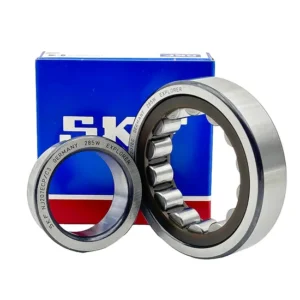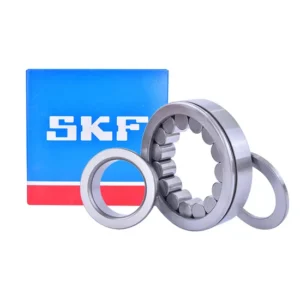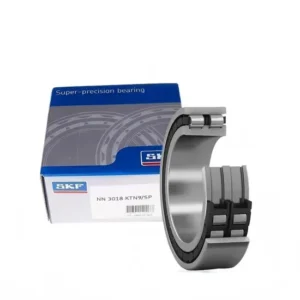


Description
Authorized Sourcing Traceability — Every SKF NN3012 KTN/SP cylinder roller bearing we dispatch ships with batch-level documentation linking it back to the manufacturer’s approved distributor network, ensuring spindle builders can trace material certificates to the original production lot.
Technical Specifications
| Parameter | Value |
|---|---|
| Designation | SKF NN3012 KTN/SP |
| Bearing Type | Double Row Cylindrical Roller Bearing |
| Bore Diameter (d) | 60 mm |
| Outside Diameter (D) | 95 mm |
| Width (B) | 26 mm |
| Bore Type | Tapered Bore (1:12) |
| Precision Class | SP |
| Number of Rows | Double Row |
| Origin | China |
| Standards | ISO 15, ISO 492 |
Note: The ‘TN’ cage suffix in this specific designation requires verification against the current manufacturer catalog to confirm the exact cage material and design generation.
Application Suitability
| Industry | Typical Applications |
|---|---|
| Industrial Machinery | CNC Machine Tool Spindle (Rear/Non-Tool End Support) |
| Metalworking | Precision Grinding Machine Spindle Shaft |
| Power Transmission | High-Rigidity Precision Gearbox Shafts |
The Cost of Ignoring SP Precision on a CNC Spindle
Running accuracy is the dividing line between a mirror finish and chatter marks on the workpiece.
When a maintenance engineer replaces an OEM spindle bearing with a standard P0 or P5 grade alternative to save on lead time, the machine often passes the initial idle runout test. However, under the cutting load and thermal growth of a continuous shift, the marginal runout error compounds. This leads to geometric inaccuracies in the machined parts and, worse, accelerated wear on the spindle journal itself. The true cost isn’t just the rejected batch of workpieces; it is the unplanned downtime required to tear down the spindle and re-grind the shaft. [NEED_CITE: impact of bearing precision class on machining surface finish]
Matching Radial Stiffness to Spindle Dynamics
The SKF NN3012 KTN/SP super precision cylindrical roller bearing is engineered specifically for the rear or non-tool end of high-speed spindles, where floating displacement is required alongside extreme radial rigidity. In a typical grinding or milling application, the tool end uses an angular contact bearing to manage axial thrust, while this double-row cylindrical unit handles the heavy radial cutting forces without binding. By sourcing through authorized channels, we ensure the geometric tolerance stack-up aligns with the spindle builder’s original stiffness calculations, preventing the "soft" feel that leads to chatter.
Thermal Growth and the Tapered Bore Challenge
CNC spindles operate in a thermally hostile environment where the shaft expands faster than the housing. The tapered bore (K suffix, 1:12 ratio) allows the installer to drive the inner ring up the tapered journal seat. This process eliminates internal radial clearance and creates a rigid, interference fit that is crucial for damping vibration. However, the interference fit must be calculated precisely; too little drive-up results in inner ring creep and fretting corrosion, while too much induces hoop stress that fractures the ring or preloads the rolling elements into thermal seizure. [NEED_CITE: spindle bearing thermal expansion and interference fit calculation]
Decoding the SP and NN Designation
The "NN" configuration indicates two rows of rollers with a flangeless outer ring and three ribs on the inner ring. This separation is critical: it allows the bearing to accommodate axial shaft expansion freely, preventing thermal binding that would occur if the outer ring were also located. The "SP" (Special Precision) class is a spindle-specific tolerance grade that sits between P5 and P4. While it shares the dimensional tolerances of P5, its running accuracy (concentricity) requirements are much tighter, approaching P4 levels. This ensures that the inner ring, once clamped to the tapered shaft, does not introduce radial runout that would compromise the SP specification.
Hidden Costs of Suffix Misinterpretation
A common failure mode occurs when a buyer matches the base number "NN3012" but ignores the precision suffix, installing a standard clearance industrial bearing in a spindle. The standard bearing lacks the controlled wall thickness variation required for a balanced interference fit. According to ISO 15243 failure classifications, this often manifests as "Surface Fatigue" or "Smearing" on the raceway within the first few hundred hours of operation. The resulting warranty claim is voided, and the machine owner is left with a spindle shaft that may require expensive metallization or replacement to restore the journal diameter. [NEED_CITE: ISO 15243 rolling bearing damage classification]
Sourcing Genuine Precision Components
We bridge the gap between factory lead times and urgent MRO needs by maintaining a sourcing protocol that prioritizes authorized distributor channels. For a designation like SKF NN3012 KTN/SP, we don’t just check the box; we verify the batch code against the manufacturer’s global database. Our cross-reference capability is vital when an OEM calls for a specific clearance or cage modification; we align the substitute bearing’s internal geometry to the application’s speed and load profile, ensuring that a replacement unit performs identically to the original equipment.
Documentation & Authenticity
- Certificate of Conformity (COC): Issued by our supply chain partner, referencing the specific batch number etched on the bearing rings for full traceability.
- Origin Identification: Clear statement of the country of manufacture (e.g., China, Malaysia, Germany) to support your customs clearance and import compliance requirements.
- Dimensional Inspection Data: Upon request, we provide third-party measurement reports confirming the 1:12 taper angle and SP running accuracy prior to dispatch.
- QR Verification Pathway: Guidance on using the official brand application to scan the laser-etched QR code, confirming the unit is not a cloned counterfeit.
- Material Certification: Access to steel mill certificates confirming the bearing steel grade meets the required hardness and purity standards for high-speed operation.
Storage, Handling & Mounting
- Original Packaging Integrity: The anti-corrosive VCI paper wrapping must remain sealed until the moment of mounting; opening it early in a humid workshop environment compromises the precision-ground raceway surface.
- Clean Room Mounting: Due to the SP precision class, installation must occur in a filtered environment to prevent micron-sized dust particles from denting the raceway and initiating premature fatigue.
- Tapered Bore Drive-Up: Use a precision locknut and dial indicator to measure the radial internal clearance reduction during mounting, ensuring the correct interference fit without crushing the roller complement.
- Temperature Control: Store the bearings horizontally in a climate-controlled area (constant temperature) to prevent thermal distortion of the thin-section inner ring before installation.
- Handling Protocol: Never drop or strike the bearing rings; use soft-jaw clamps or induction heaters for installation, avoiding localized thermal shock that alters the metallurgical structure.
Verify Your Spindle Fitment
To confirm this SKF NN3012 KTN/SP super precision cylindrical roller bearing is the correct replacement for your equipment, please share your OEM machine model number or the exact shaft journal dimensions. We will perform a cross-reference check to verify the taper ratio and precision suffix match your application’s rigidity requirements, and provide a formal quotation including the estimated lead time and available documentation package.
Frequently Asked Questions
Q: What is the difference between SP and P5 precision for this bearing?
A: While both share similar dimensional tolerances, SP (Special Precision) mandates tighter running accuracy, specifically regarding the radial runout of the inner ring and outer ring. This is essential for spindle applications where the bearing inner ring is clamped to a tapered shaft, as any wall thickness variation would translate directly to tool tip vibration.
Q: How do I verify the authenticity of the TN cage suffix?
A: Cage material codes can change over time or vary by production plant. We recommend verifying the specific cage material (e.g., glass-fiber reinforced polyamide or machined brass) via the official manufacturer’s current catalog or app, using the unique serial number on the packaging, to ensure it is rated for your spindle’s maximum operating speed and temperature.
Q: Can I use this bearing in a standard industrial gearbox?
A: Yes, the NN3012 KTN/SP is dimensionally interchangeable with standard industrial versions. However, using an SP precision bearing in a general-purpose gearbox is typically an unnecessary cost. We can help you identify a standard P0 or P6 alternative with the correct clearance if the application does not demand spindle-level running accuracy.
Q: What documentation supports the country of origin?
A: We provide a commercial invoice and packing list that explicitly state the country of manufacture, supported by the manufacturer’s Certificate of Origin where required by your local customs authority, facilitating smooth import processing for high-value precision components.
Finalize Your Spindle Rebuild Strategy
Submit your inquiry with the machine serial number or spindle drawing, and our technical team will confirm the fitment parameters and sourcing timeline.
[Contact our technical sourcing desk via the inquiry form for immediate batch availability checks.]