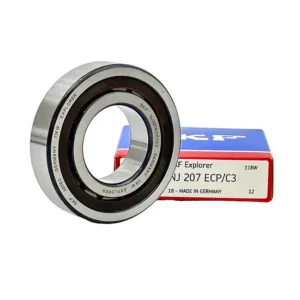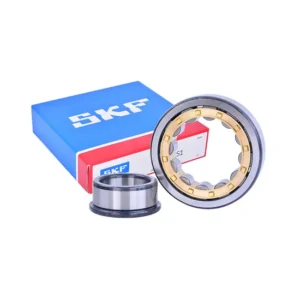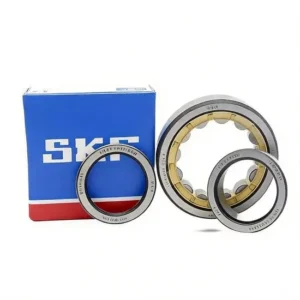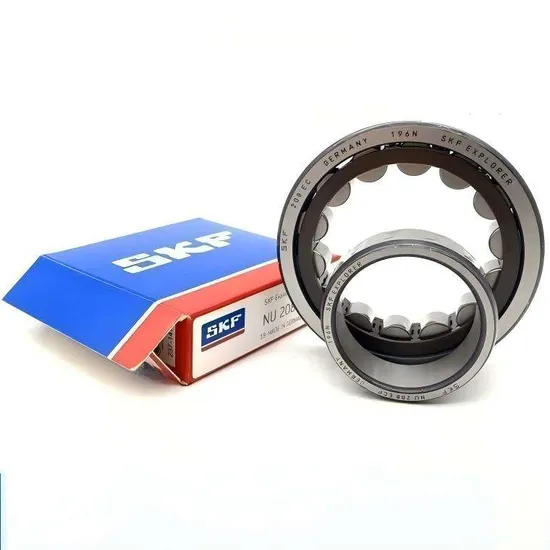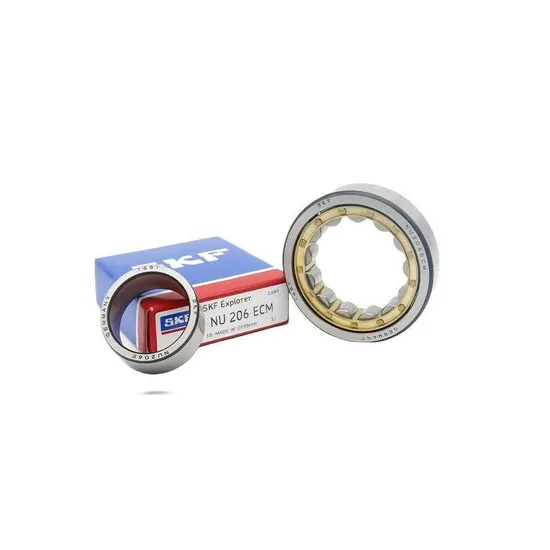


Description
Traceable Sourcing Channel — Every SKF NN 3011KTN/SPVR521 shipped with authorized distributor Certificate of Conformity and batch-level traceability for import documentation and authenticity audits.
Technical Specifications
| Parameter | Value |
|---|---|
| Designation | SKF NN 3011KTN/SPVR521 |
| Bearing Type | Double Row Cylindrical Roller Bearing |
| Bore Diameter (d) | 55 mm |
| Outside Diameter (D) | 90 mm |
| Width (B) | 26 mm |
| Weight | 0.800 kg |
| Cage Material | TN9 — Injection Molded Glass Fiber Reinforced Polyamide 6,6 |
| Seal or Shield Type | Open |
| Bore Type | Tapered Bore (1:12 taper, K suffix) |
| Number of Rows | Double Row |
| Precision Class | SP |
| Origin | China |
Note: /SP and /VR521 suffixes require confirmation against the manufacturer catalog for full application-specific decoding.
Application Suitability
| Industry | Typical Applications |
|---|---|
| Industrial Machinery | Machine tool main spindles with high-speed rotary requirements |
| Precision Equipment | High-precision indexing heads and rotary tables |
| General MRO | Replacement bearings for OEM high-speed industrial gearboxes |
What Happens When Suffix Blind Spots Kill a Spindle
The base number is never the whole story for super-precision cylindrical roller bearings.
Procurement teams frequently match the NN 3011 designation and move straight to price comparison, leaving the K bore taper, TN9 cage, and SP precision class as fine print. That shortcut produces real failures: a TN9 polyamide cage forced into an application exceeding its thermal boundary will soften and crack unevenly under roller loading [NEED_CITE: polyamide cage thermal limits in high-speed spindle applications]. A standard clearance bearing substituted where the tapered bore demands a specific interference fit leaves residual clearance too loose — introducing vibration that destroys running accuracy within weeks. The SKF NN 3011KTN/SPVR521 demands every suffix read as an operating condition, not a catalog decoration.
How the Tapered Bore and Polyamide Cage Serve Spindle Duty
Machine tool spindles demand two things simultaneously: rigid radial guidance under cutting loads and minimal heat generation at sustained high rotational speeds. The SKF NN 3011KTN/SPVR521 meets both through its tapered bore design, which mounts directly onto a precision-ground tapered shaft seat — eliminating the adapter sleeve that would otherwise add a compliance layer and reduce rotational accuracy. We regularly cross-check this configuration against NSK and FAG equivalents for buyers consolidating supply chains, always verifying that cage material and precision class align, not just the bore diameter and OD.
Thermal Expansion, Residual Clearance, and What the Shop Floor Actually Sees
The operating temperature inside a high-speed spindle easily climbs beyond ambient by a significant margin, and that heat differential between the inner ring and shaft changes the interference fit established at room temperature. If the initial drive-up distance on the tapered seat is wrong, the residual internal clearance either collapses into preload — generating excess friction heat and accelerating cage wear — or stays too loose, allowing roller skew that marks the raceway. Open-type bearings like this one depend entirely on the machine builder’s external lubrication circuit and sealing arrangement, placing contamination defense and re-lubrication intervals outside the bearing itself [NEED_CITE: open bearing contamination sensitivity in spindle environments].
Reading the Suffix Stack: TN9, SP, and the 1:12 Taper
The TN9 cage is injection molded from glass fiber reinforced polyamide 6,6 — a material chosen specifically for high-speed applications where cage weight directly affects friction heat and centrifugal stress on cage pockets. It operates within defined temperature boundaries and is incompatible with certain synthetic lubricants that attack polyamide. The SP precision class sits above standard P0 and P6 grades, delivering tighter dimensional and running accuracy for applications where spindle runout must stay minimal. The K suffix indicates a 1:12 tapered bore, meaning the shaft seat must be ground to that exact taper and the inner ring driven up a calculated axial distance to achieve the target residual clearance — a process requiring a dial indicator and experience, not a torque wrench guess.
The Downtime Math Behind a Wrong Substitution
Swapping an SP-class bearing for a P0 equivalent to cut unit cost seems rational on a purchase order. In the field, that decision surfaces as chatter marks on machined surfaces, scrapped workpieces, and eventually a spindle teardown that takes the machine offline for days. ISO 15243 catalogs failure modes that trace directly back to precision mismatches and improper mounting — spalling patterns, cage fractures, and raceway smearing all carry signatures that point back to the selection decision [NEED_CITE: ISO 15243 rolling bearing failure mode classification]. Unplanned downtime on a CNC spindle carries costs far beyond the bearing price: lost production shifts, emergency freight for replacements, and scrap material add up quickly.
What We Bring to the Table Beyond the Part Number
Sourcing genuine SKF product requires documentation that survives customs audits and buyer verification — not just a brand logo on a box. We procure through authorized distributor channels, so every order carries a Certificate of Conformity tied to a traceable batch. When a buyer needs to cross-reference this SKF NN 3011KTN/SPVR521 against an NSK or FAG equivalent already specified in legacy equipment documentation, we verify bore taper, cage material, and precision class alignment before proposing the substitution — because a base-number match with a mismatched suffix is a field failure waiting to happen. Origin documentation ships with every consignment for import compliance.
Documentation & Authenticity
- Supplier Certificate of Conformity with batch and lot traceability linked to this specific production run
- Third-party dimensional inspection report verifying tapered bore geometry and SP precision class runout before dispatch
- QR code verification pathway through the SKF official app for end-user authenticity confirmation
- Country-of-origin documentation and HS code details prepared for import clearance at destination port
- Material certificate confirming bearing steel specification consistent with the manufacturer’s production standards
Storage, Handling & Mounting
- Retain original sealed packaging until the moment of mounting; early exposure to workshop humidity compromises the corrosion protection on this open-type bearing
- The tapered bore demands a clean, precisely ground 1:12 shaft seat — any debris or taper error causes uneven inner ring seating and destroys the SP running accuracy
- Use clean, lint-free gloves when handling the exposed rolling surfaces; the TN9 polyamide cage pockets are sensitive to particulate contamination that accelerates wear
- Drive-up distance on the tapered seat must be measured with a dial indicator to achieve correct residual clearance — thermal expansion at operating temperature will reduce the clearance established at ambient
- Confirm lubricant compatibility with polyamide 6,6 before introducing the spindle oil circuit; certain EP additives attack TN9 cage material over time
Request a Quotation or Technical Review
Share your spindle operating parameters — speed range, radial load profile, and operating temperature — so we can confirm whether this configuration suits your application, or propose a cross-brand equivalent with all suffixes aligned. If you are replacing an existing bearing, provide the OEM equipment number and we will verify the full designation match against your machine documentation. Request the documentation package upfront to confirm origin and batch traceability before committing to volume.
Frequently Asked Questions
Q: How do I verify the authenticity of an SKF bearing after delivery?
A: SKF provides an official mobile app with QR code scanning capability that links each product to its production records. We additionally supply a Certificate of Conformity with batch traceability from the authorized distributor channel, so you have both digital and documentary verification paths.
Q: What must align when cross-referencing this bearing to another brand?
A: Base number alone is insufficient. The bore taper ratio, cage material (TN9 polyamide vs. brass or steel), and precision class (SP vs. standard grades) must all be matched in the substitute. We perform this three-axis verification before proposing any NSK, FAG, or NTN equivalent.
Q: What is the difference between SP precision and standard P grades?
A: SP precision delivers tighter dimensional tolerances and running accuracy than P0 or P6, designed for applications where minimal spindle runout is required. It sits in the super-precision range alongside P4 and UP classes used in demanding machine tool applications.
Q: How should the tapered bore be mounted on the shaft?
A: The 1:12 tapered bore requires a shaft seat ground to that same taper. The inner ring is driven up axially a specific distance to establish correct residual internal clearance — measured with a dial indicator, not estimated. Incorrect drive-up leads to either thermal binding or loose operation.
Q: What lubricants are compatible with the TN9 polyamide cage?
A: TN9 cages are compatible with most standard mineral and synthetic spindle oils, but certain lubricants with aggressive EP additives can degrade polyamide 6,6 over extended exposure. Confirm lubricant compatibility with the manufacturer’s technical data before commissioning.
Secure Your SKF NN 3011KTN/SPVR521 with Full Traceability
Send us your application parameters or OEM equipment number to initiate the technical review and receive a quotation with confirmed lead time and documentation package.