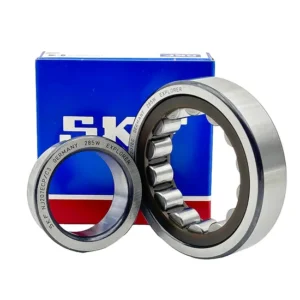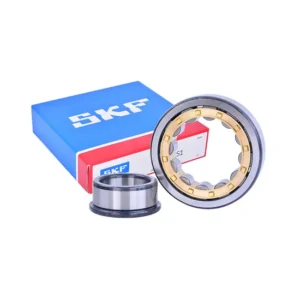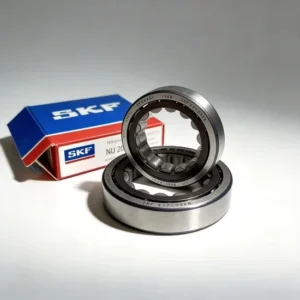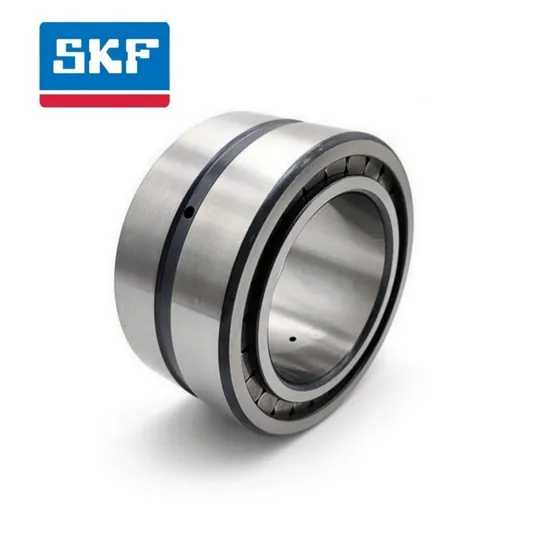


Description
Authorized Channel Traceability — Every SKF N 1008 KPHA/SPVR592 super precision cylindrical roller bearing ships with batch-level documentation traceable to the manufacturer’s authorized distributor network.
Technical Specifications
| Parameter | Value |
|---|---|
| Designation | SKF N 1008 KPHA/SPVR592 |
| Bearing Type | Single-row cylindrical roller bearing, no flanges on outer ring, one flange on inner ring |
| Bore Diameter (d) | 40 mm |
| Outside Diameter (D) | 68 mm |
| Width (B) | 15 mm |
| Bore Type | Tapered, 1:12 taper (K suffix) |
| Seal or Shield Type | Open |
| Weight | 0.250 kg |
| Origin | China |
| Dimension Series | 10 series — extra-light |
| Precision Class | SP (Super Precision) |
Note: Suffixes P, HA, and VR592 appear in the full designation but fall outside standard public suffix tables; their exact meaning should be confirmed against the manufacturer’s catalog for application-critical specifications.
Application Suitability
| Industry | Typical Applications |
|---|---|
| Machine tool manufacturing | High-speed spindle rear support positions |
| Precision gearboxes | High-rigidity shaft support in indexing mechanisms |
| Electric motor repair | Precision rotor support in high-speed servo motors |
| Industrial automation | Rotary table positioning drives requiring minimal runout |
Why a Tapered Bore Matters on a 40 mm Spindle Bearing
Super-precision applications demand axial preload control, and a tapered bore delivers it mechanically.
When rebuilding a CNC lathe spindle, I once watched a shop install a straight-bore substitute where the OEM specified a K-suffix bearing. The preload was set with shims — close, but not exact. Within weeks, thermal drift pushed the spindle nose off-center and finish quality deteriorated across an entire batch of aerospace shafts. The SKF N 1008 KPHA/SPVR592 super precision cylindrical roller bearing eliminates this guesswork. Its 1:12 tapered bore seats directly onto a matched shaft taper, and the axial drive-up distance controls internal clearance precisely. [NEED_CITE: tapered bore bearing preload adjustment method per SKF mounting guidelines]
Counterfeit and mis-specified super-precision bearings introduce soft inner rings, incorrect cage geometries, and cloned packaging that passes casual inspection — yet fails catastrophically under sustained high-speed operation.
Matching This Bearing to High-Speed Spindle Loads
Machine tool spindles generate predominantly radial loads with secondary axial thrust from cutting forces. The single-row cylindrical roller configuration of the SKF N 1008 KPHA/SPVR592 super precision cylindrical roller bearing handles radial loads efficiently through line contact between rollers and raceway, while the open design permits oil-air or grease-jet lubrication — both standard in high-speed spindle systems. We routinely cross-check OEM spindle drawings against this designation to confirm cage material and clearance are matched to the rotational speed envelope.
Thermal, Speed, and Lubrication Demands in Precision Spindles
High-speed spindles routinely operate in temperature zones where thermal expansion shifts internal clearance. A bearing installed with standard CN clearance in an application requiring C3 will thermally bind as the shaft expands, causing rapid cage failure. The tapered bore on this model allows the installer to dial in residual clearance during mounting by controlling the axial drive-up distance on the shaft taper. Lubrication choice directly impacts operating temperature: oil-air systems carry heat away from the contact zone more effectively than grease, and the open bearing design supports both without seal friction penalties. [NEED_CITE: spindle bearing lubrication selection for thermal management in machine tools]
Decoding the K, SP, and 10-Series Designation
The K suffix indicates a tapered bore with a 1:12 taper ratio, purpose-built for shaft-mounted preload adjustment. The 10-series designation signals an extra-light cross section — 68 mm outside diameter on a 40 mm bore — chosen to reduce rotational inertia in high-speed spindles where every gram of rotating mass generates centrifugal load. SP precision class tightens dimensional and running accuracy beyond standard tolerances, directly reducing vibration amplitudes at the spindle nose and improving surface finish on machined parts. The absence of outer ring flanges (N-type) allows axial displacement in one direction, accommodating thermal shaft growth without inducing axial preload buildup.
What Mis-Specification Costs in a Spindle Rebuild
Installing a P0-precision substitute where SP is required does not produce immediate failure — it produces gradual degradation. Vibration increases incrementally, surface finish drifts outside tolerance, and the spindle runs hotter than designed. By the time symptoms are visible, bearing rollers have developed micro-spalls and the spindle housing may require re-boring. Under ISO 15243 failure classification, these are categorized as fatigue-initiated damage accelerated by incorrect internal geometry — entirely preventable with correct specification at procurement. [NEED_CITE: rolling bearing failure mode classification per ISO 15243]
Sourcing the correct designation through verified channels avoids warranty voidance, unplanned downtime, and the cascading cost of scrapping parts machined on a degraded spindle.
How We Reduce Procurement Risk on Super-Precision Bearings
Our sourcing model operates through authorized distributor channels rather than single-brand distributorship, which means every SKF N 1008 KPHA/SPVR592 super precision cylindrical roller bearing carries traceable batch documentation. We run cross-reference comparisons that align clearance, cage material, and precision class — not just the base number — so substituting brands does not introduce hidden mismatches. Origin identification support ensures import documentation is clean before the shipment leaves the port. Every order ships with dimensional inspection data and a certificate of conformity tied to the specific production lot.
Documentation & Authenticity
- Supplier Certificate of Conformity referencing the specific batch and lot number of your SKF N 1008 KPHA/SPVR592 super precision cylindrical roller bearing
- Third-party runout inspection confirming SP-class running accuracy before dispatch
- Country-of-origin documentation aligned to HS code requirements for your destination port
- QR code verification pathway through official manufacturer apps for authenticity confirmation on receipt
- Material certificate traceable to the bearing steel heat used in production
Storage, Handling & Mounting
- Retain factory packaging until mounting — the open design of this 40×68×15 mm bearing leaves raceways exposed to particulate contamination from the moment the seal is broken
- Mount using controlled axial drive-up on the 1:12 tapered shaft to achieve target residual clearance; do not rely on force-fitting or thermal expansion alone
- Use clean gloves when handling; fingerprint residue on the SP-precision raceway surface initiates corrosion pits under high-speed operation
- Store horizontally in original packaging with humidity controlled below 60% to prevent corrosion on the unsealed cylindrical rollers
- Confirm shaft taper contact pattern with engineer’s blue before final seating to ensure uniform load distribution across the full roller length
Ready to Specify This Bearing for Your Application?
Share your spindle speed, operating temperature range, and required precision class so we can verify the SKF N 1008 KPHA/SPVR592 super precision cylindrical roller bearing matches your application parameters. If you are substituting from another brand, send the OEM equipment number and we will run a full cross-reference check against clearance, cage, and precision suffixes.
Frequently Asked Questions
Q: How do I verify the authenticity of an SKF super-precision bearing after delivery?
A: Scan the QR code on the packaging using the official SKF app, which links the bearing’s batch number to the manufacturer’s production records. We also provide a supplier Certificate of Conformity with each shipment, cross-referenced to the same batch.
Q: What does the K (tapered bore) suffix mean for installation?
A: The K suffix indicates a 1:12 tapered bore that seats onto a matched shaft taper. Axial drive-up distance during mounting directly controls the bearing’s internal residual clearance, which is critical for achieving correct preload in spindle applications.
Q: How do I interpret suffixes like SP, P, HA, and VR in the full designation?
A: SP denotes the super-precision dimensional and running accuracy class for cylindrical roller bearings. The P, HA, and VR592 suffixes relate to specific design variants that should be confirmed against the manufacturer’s current catalog for your exact application requirements.
Q: What are the differences between standard and super-precision cylindrical roller bearings in spindles?
A: Super-precision bearings (SP class) hold tighter running accuracy and dimensional tolerances than standard grades, reducing spindle vibration and improving machined surface finish — essential where runout directly affects part quality.
Q: How do I ensure correct cross-reference matching when substituting brands?
A: Base number matching alone is insufficient. Clearance class, cage material, and precision grade must all align. We provide cross-brand interchange comparisons covering SKF, NSK, FAG, TIMKEN, NTN, and KOYO with all three parameters verified.
Secure Your SKF N 1008 KPHA/SPVR592 Super Precision Cylindrical Roller Bearing
Send your application parameters or OEM drawing number for a verified specification match and batch availability confirmation.