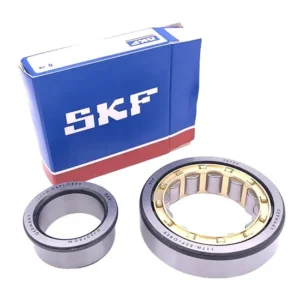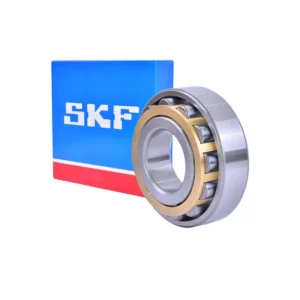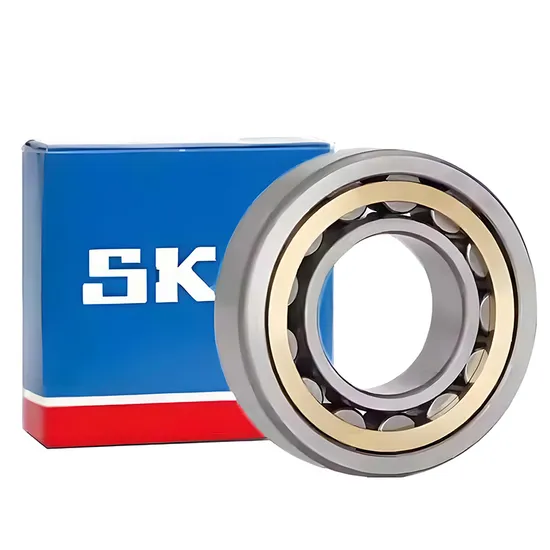


Description
Traceable Origin Documents — Every shipment of this super precision spindle bearing includes verifiable country-of-origin paperwork and batch-level conformity records aligned with import compliance requirements.
Technical Specifications
| Parameter | Value |
|---|---|
| Designation | SKF NN 3013 KTN/UP |
| Bearing Type | Double Row Cylindrical Roller Bearing |
| Bore Diameter (d) | 65 mm |
| Outside Diameter (D) | 100 mm |
| Width (B) | 26 mm |
| Weight | 0.250 kg |
| Bore Type | Tapered (1:12) |
| Seal or Shield Type | Open |
| Number of Rows | Double Row |
| Precision Class | UP (Ultra Precision) |
| Cage Material | Polyamide (TN) |
| Origin | China |
Note: The specific suffixes K, TN, and /UP relate to bore geometry, cage material, and precision class respectively; exact definitions should be confirmed against the manufacturer catalog prior to final specification.
Application Suitability
| Industry | Typical Applications |
|---|---|
| Machine Tool Manufacturing | High-speed CNC lathe spindles, internal grinding head assemblies |
| Precision Industrial Gearboxes | High-rigidity shaft supports in indexing and dividing mechanisms |
| Steel and Metallurgy | Rolling mill work roll neck journals requiring minimal radial runout |
| General Industrial Machinery | High-precision rotary tables and dividing heads |
The Thermal Binding Risk on High-Speed Spindles with the SKF NN 3013 KTN/UP
Correct clearance selection prevents spindle seizure under sustained thermal growth.
When a standard CN clearance bearing is pressed into a tight spindle housing without accounting for operating temperature rise, the inner ring expands against the shaft and the outer ring contracts within the bore. The resulting radial internal clearance collapses. I have seen this exact scenario in a Sharjah CNC shop where a substitute bearing—matching the base number but lacking the correct precision suffix—caused chatter marks across every machined surface within forty minutes of operation. The SKF NN 3013 KTN/UP super precision double row cylindrical roller bearing addresses this by holding dimensional tolerances that allow predictable interference fits without unplanned preload buildup. [NEED_CITE: thermal expansion effects on bearing radial internal clearance in machine tool spindles]
Matching the Spindle Load Spectrum to Bearing Geometry
The NN design series places all roller-guiding flanges on the inner ring, leaving the outer ring flangeless. This configuration allows the outer ring to float axially within the housing, accommodating the thermal shaft growth that occurs during extended high-speed cuts. For a 65 mm bore spindle operating under heavy radial cutting forces, the double row arrangement distributes load across a wide contact footprint, reducing unit loading on each roller element. The SKF NN 3013 KTN/UP super precision double row cylindrical roller bearing is purpose-matched for these conditions—high radial rigidity, axial float capability, and the dimensional stability that precision boring demands. When sourcing replacements for OEM spindle assemblies, we cross-verify not just the base designation but the full suffix string, ensuring the taper bore geometry and polyamide cage specification align with the original installation parameters.
Spindle Speed, Lubrication, and Contamination Pressures
High-speed spindle applications demand careful attention to the lubrication regime. Open-type bearings like this unit require external lubrication routing—typically oil-air or oil mist systems that deliver precisely metered lubricant directly to the roller-raceway contact zone. Sealed alternatives would introduce contact friction incompatible with the rotational speeds these spindles reach. The tapered bore allows the installer to drive the inner ring onto the shaft with a measured axial displacement, setting the residual radial clearance precisely. This is critical because excess clearance produces vibration at speed, while insufficient clearance causes thermal runaway. The polyamide cage keeps weight low at the roller guiding surfaces, reducing centrifugal loading at elevated rpm. [NEED_CITE: lubrication method selection for super precision cylindrical roller bearings in high-speed spindle service]
Decoding the Suffix Architecture
The K suffix denotes a tapered bore with a 1:12 ratio—a design feature that enables fine clearance adjustment during mounting by controlling how far the inner ring is driven up the taper. This is the preferred bore configuration for machine tool spindles because it allows the fitter to dial in the exact operating clearance after accounting for interference fit expansion. The TN designation indicates a polyamide cage, which offers low mass and favorable sliding properties at the roller guiding surfaces, keeping friction and heat generation contained during sustained high-speed operation. The /UP precision class represents ultra-precision tolerances—tighter than standard SP grades—delivering the minimal radial runout that precision ground surfaces demand. When these three suffixes work together, they define a bearing that can be installed with exacting clearance control, spin at high speed without cage-induced heating, and hold the geometric accuracy that eliminates chatter from finished workpieces.
The Hidden Price of a Suffix Shortcut
Substituting a standard-precision cylindrical roller bearing where an ultra-precision unit is specified does not produce an immediate, obvious failure. Instead, the runout exceeds the spindle tolerance budget, and the machine begins generating surface defects that may not be caught until the next quality audit. Unplanned downtime follows as the spindle is pulled for rework. In some cases, the vibration accelerates wear on adjacent seals and drawbar mechanisms, turning a single bearing substitution into a cascading mechanical issue. ISO 15243 catalogs these progressive failure modes, and a significant share of premature spindle failures trace back to precision mismatches rather than material defects. [NEED_CITE: bearing failure mode classification per ISO 15243]
Why Sourcing Channels Define Spindle Bearing Reliability
Genuine SKF bearings sourced through authorized distributor channels carry batch-level traceability that unverified supply chains simply cannot match. We supply the SKF NN 3013 KTN/UP super precision double row cylindrical roller bearing with full Certificate of Conformity documentation, allowing you to verify the production batch, the manufacturing facility origin, and the precision test records. Our cross-reference database matches not only the base designation but also the cage material, clearance class, and precision suffix—so if you are replacing a competitor’s equivalent, you receive a functionally identical substitute rather than a number-only match. For buyers in regions where counterfeit bearings with cloned packaging circulate, we provide QR code verification pathways through the official brand application and country-of-origin documentation that supports smooth import clearance.
Documentation & Authenticity
- Certificate of Conformity tied to the specific production batch of this 65 mm bore ultra-precision bearing, confirming dimensional accuracy and running precision
- Origin documentation package including HS code references, enabling import compliance for buyers in the Middle East, Africa, and Latin America
- QR code verification pathway accessible via the official SKF application for field-level authenticity confirmation
- Dimensional inspection records verifying that the tapered bore geometry and outer ring diameter meet the specified tolerance band before dispatch
- Material and heat treatment certificates documenting the bearing steel specification and hardening process for quality audit trails
Storage, Handling & Mounting
- Keep the original sealed packaging intact until the moment of mounting; exposing the polyamide cage and precision-ground raceways to shop-floor humidity degrades the rust-preventive coating on this open-type bearing
- Mount the tapered bore inner ring using the axial drive-up method with a calibrated hydraulic nut, measuring the displacement to achieve the target residual clearance rather than relying on torque values alone
- Handle with lint-free clean gloves to prevent transfer of skin salts onto the 100 mm outer ring surface, which can initiate corrosion under oil-air lubrication conditions
- If storing beyond a few weeks, maintain the package in a climate-controlled area with stable temperature to prevent condensation inside the wrapping of this super precision component
- Confirm shaft taper geometry and surface finish before installation, as any deviation on the mating shaft compromises the interference fit critical to high-speed spindle performance
Request a Technical Quotation
Share your spindle operating parameters—including speed range, load profile, and operating temperature—so we can confirm the suitability of this bearing and verify clearance requirements against your housing fit. If you are replacing an existing bearing, provide the OEM equipment number or the full designation from the original nameplate, and we will complete a cross-reference check covering precision class, cage type, and bore geometry. Documentation packages, batch availability, and lead times can be confirmed upon request.
Frequently Asked Questions
Q: How do I verify the authenticity of the SKF NN 3013 KTN/UP before installation?
A: Each unit we supply includes a Certificate of Conformity with batch traceability. You can also scan the QR code on the packaging using the official SKF application to confirm the product against the manufacturer’s records. For additional confidence, we provide third-party dimensional inspection reports upon request.
Q: What do the suffixes K, TN, and /UP indicate on this bearing?
A: K denotes a 1:12 tapered bore, TN specifies a polyamide cage, and /UP indicates an ultra-precision tolerance class that exceeds standard SP grades. These suffixes should be confirmed against the manufacturer catalog to ensure full alignment with your application requirements.
Q: Can I substitute a different precision class if UP stock is limited?
A: Substituting a lower precision class such as SP or P4 into a spindle designed for UP tolerances risks exceeding the runout budget, which manifests as surface finish defects and elevated vibration. We recommend consulting with our technical team before accepting any precision downgrade, as the application envelope must be reassessed.
Q: How does the tapered bore affect installation compared to a cylindrical bore?
A: The tapered bore allows the installer to set the radial internal clearance precisely by controlling the axial displacement of the inner ring during mounting. This is particularly valuable in spindle applications where the interference fit between the shaft and inner ring reduces clearance, and the residual value must fall within a narrow operating window.
Q: What cross-reference checks are performed when substituting another brand?
A: We verify the base dimensions, bore type, cage material, and precision class together—not just the numeric designation. A match on the base number alone can miss critical differences in clearance, cage design, or running accuracy that cause field failures.
Secure Your Spindle Bearing Supply
Send your application details or OEM equipment number to initiate a technical review and receive a formal quotation with confirmed documentation and lead time.