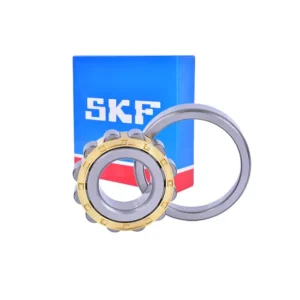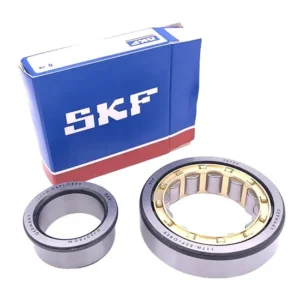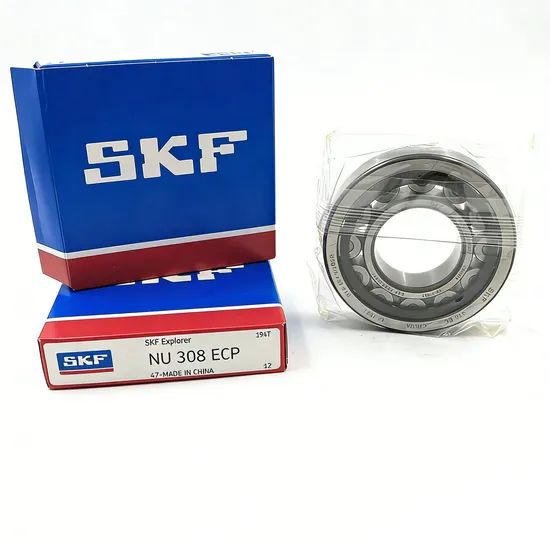


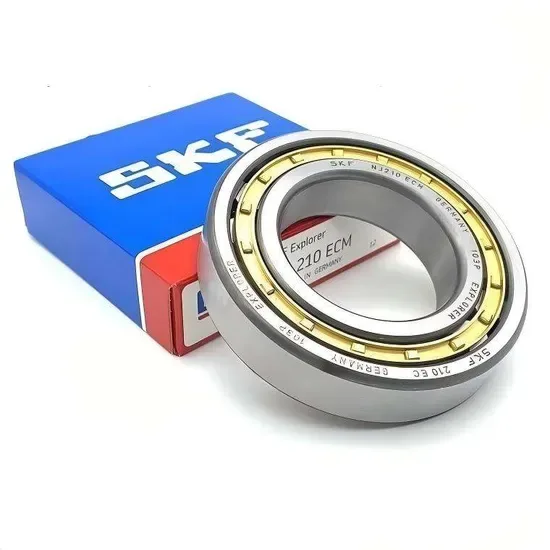
Description
Authorized Channel Sourcing — Full batch traceability and certificate of conformity accompany every SKF NN3026KTN9/SPVR5220 shipment, verified against SKF production records.
Technical Specifications
| Parameter | Value |
|---|---|
| Designation | SKF NN3026KTN9/SPVR5220 |
| Bearing Type | Double Row Cylindrical Roller Bearing |
| Bore Diameter (d) | 130 mm |
| Outside Diameter (D) | 200 mm |
| Number of Rows | Double Row |
| Bore Type | Tapered, 1:12 taper |
| Cage Material | Polyamide 6,6 (glass fiber reinforced) |
| Seal or Shield Type | Open |
| Precision Class | SP |
| Structure | Cylindrical |
| Material | Bearing Steel |
| Origin | China |
Note: The VR5220 suffix is a manufacturer-specific variant designation; confirm application limits with the factory technical sheet before finalizing installation parameters.
Application Suitability
| Industry | Typical Applications |
|---|---|
| Machine Tool Manufacturing | Lathe and milling machine main spindles |
| Industrial Gearbox Production | High-precision gear reduction shafts |
| Steel and Metallurgy | Rolling mill guide rollers and tension levelers |
| Precision Machinery | Rotary indexing tables and grinding wheel spindles |
What Happens When a Tapered Bore Gets the Wrong Clearance on a Precision Spindle
The spindle locks within hours — and the line stops until someone traces the thermal binding back to the bearing seat.
A rolling mill in Central Europe once installed an NN 30 series double row cylindrical roller bearing with standard internal clearance on a spindle running continuously above 100°C. Nobody checked whether C3 clearance was required for that thermal envelope. Within two weeks, expansion closed the internal gap entirely, and the rollers seized against the raceway. Four days of unplanned downtime followed before the root cause surfaced during teardown. That schedule loss still shapes how every tapered bore inquiry is handled here: full suffix verification before any quotation leaves the desk [NEED_CITE: thermal expansion effects on bearing internal clearance per ISO 5753].
Matching the SKF NN3026KTN9/SPVR5220 to Precision Spindle Loads
Machine tool spindles demand simultaneous radial rigidity and rotational accuracy. The SKF NN3026KTN9/SPVR5220 double row cylindrical roller bearing addresses both through its twin-row roller complement and SP precision class, holding runout within the envelope required by grinding and milling spindles. The tapered 1:12 bore allows interference fit adjustment via shaft seat or adapter sleeve, giving maintenance crews direct control over residual clearance after mounting — a critical variable when spindle speeds push the polyamide cage toward its thermal ceiling. When a buyer substitutes a brass-cage equivalent without verifying speed ratings, cage wear patterns shift unpredictably, and vibration signatures drift outside acceptable limits within the first service interval.
Operating Environments That Expose Specification Gaps
Radial loads dominate in spindle applications, but the occasional axial displacement from thermal shaft growth or cutting force transients still reaches the bearing shoulders. Temperatures inside enclosed gearboxes or spindle housings routinely exceed ambient by significant margins, and that heat directly compresses the internal clearance window. The TN9 glass-fiber reinforced polyamide cage performs well up to its material temperature limit, but oil-mist or grease lubrication must be matched to both the cage material and the speed range to prevent lubricant breakdown. Open bearing construction means the housing seal design carries full responsibility for contamination exclusion — a detail frequently overlooked when retrofitting older machine frames. Installation on a tapered seat demands measured axial drive-up to achieve the specified interference, and overshooting that distance collapses internal clearance just as surely as a thermal overload would [NEED_CITE: tapered bore mounting drive-up procedures for cylindrical roller bearings].
Decoding the Suffix Chain: What Each Designator Controls
The K suffix confirms the 1:12 tapered bore, a geometry that enables precise interference fit adjustment during mounting by controlling axial displacement along the taper. This is the mechanism that lets technicians dial in residual clearance after the bearing seats on the shaft. The TN9 cage, injection-molded from glass-fiber reinforced polyamide 6,6, keeps weight low and sliding friction minimal — properties that matter when the spindle accelerates through critical speeds. Polyamide also dampens cage-roller contact noise, though it imposes a strict upper temperature boundary that brass cages do not share. The SP precision class places this bearing in the super-precision tier, holding bore and outside diameter tolerances tighter than P5 specifications, which directly translates to lower runout on the finished spindle assembly. Double row NN construction means the inner ring carries two flanges while the outer ring is separable, simplifying mounting sequences in tight housing bores [NEED_CITE: SKF super-precision cylindrical roller bearing suffix conventions].
The Hidden Expense of Skipping Suffix Verification
Correct specification paired with documented provenance keeps spindle uptime predictable. The alternative — accepting a bearing that matches the base number but substitutes cage material, ignores bore taper, or ships with unverified precision — introduces failure modes catalogued in ISO 15243 that range from surface smearing to cage fracture. A single premature spindle failure on a production lathe or rolling mill guide roller cascades into unplanned downtime, scrapped workpieces, and warranty disputes that dwarf the original bearing cost. Counterfeit polyamide cages, molded from unreinforced resin, soften at temperatures the genuine TN9 material handles routinely, and the resulting cage deformation leads to roller skew and raceway scoring within days [NEED_CITE: rolling bearing failure mode classification per ISO 15243].
Why Procurement Engineers Route Spindle Bearing Inquiries Here
Every SKF NN3026KTN9/SPVR5220 double row cylindrical roller bearing ships with a traceable batch record linking it back through authorized distribution channels. The cross-reference database matches clearance class, cage material, and precision grade simultaneously — not just the base designation — so substitution proposals for NSK or FAG equivalents arrive fully verified. Authenticity verification extends beyond paperwork: QR code pathways connect to official brand applications for real-time lot confirmation. For import-bound orders, country-of-origin documentation and HS code support travel with the commercial invoice, eliminating customs delays. Technical selection review covers application parameters before a quote is issued, catching bore taper or clearance mismatches at the inquiry stage rather than after the bearing reaches the machine floor.
Documentation & Authenticity
- Certificate of Conformity with lot-level batch traceability tied to the SKF production facility
- Material test certificate confirming bearing steel grade and heat treatment compliance
- Dimensional inspection report verifying bore taper ratio, OD tolerance, and width against SP precision limits
- QR code verification pathway through official SKF authentication applications
- Country-of-origin certificate and HS code documentation for customs clearance
Storage, Handling & Mounting
- Retain factory packaging until the moment of mounting; premature exposure risks contamination of the open raceways and rollers on this SKF NN3026KTN9/SPVR5220
- Store in a humidity-controlled environment below the condensation threshold to protect the unsealed bearing steel surfaces from corrosion before installation
- Use lint-free gloves when handling the exposed rollers and TN9 polyamide cage to prevent skin oil transfer onto precision-ground surfaces
- Mount on the 1:12 tapered seat using measured axial drive-up; verify residual internal clearance with a feeler gauge or dial indicator after the interference fit is established
- Confirm housing seal integrity independently, as the open bearing design places full contamination exclusion responsibility on the external sealing system
Requesting a Quotation with Full Technical Alignment
Share your spindle speed range, operating temperature envelope, and shaft seat dimensions so the taper fit and residual clearance can be confirmed against your specific application. Provide the OEM equipment designation or drawing number to trigger a cross-reference verification against the full suffix chain. Request the documentation package — including batch traceability and origin certificates — alongside the commercial offer to streamline your import and receiving inspection workflow.
Frequently Asked Questions
Q: How do I verify the authenticity of the SKF NN3026KTN9/SPVR5220 through official channels?
A: Each bearing carries a traceable batch code that can be cross-checked through SKF’s official authentication applications via QR scan or manual entry. The Certificate of Conformity supplied with the shipment provides the lot number needed for this verification step.
Q: What does the K suffix mean, and how does it affect installation?
A: The K suffix indicates a 1:12 tapered bore. During mounting on a matching tapered shaft seat or adapter sleeve, axial displacement along the taper determines the interference fit and residual internal clearance, making controlled drive-up essential.
Q: How does the TN9 polyamide cage compare to a brass cage for spindle use?
A: The TN9 glass-fiber reinforced polyamide cage offers lower weight, reduced sliding friction, and quieter operation at high speeds compared to machined brass cages. However, it has a lower maximum operating temperature, so the lubrication regime and thermal environment must stay within polyamide limits.
Q: What should I verify when cross-referencing this bearing to another brand?
A: Beyond the base designation, confirm that the substitute matches the K tapered bore, TN9 polyamide cage material, and SP precision class. Mismatches in any of these three parameters alter mounting procedure, speed capability, or running accuracy.
Q: How is tapered bore cylindrical roller bearing clearance measured after mounting?
A: After driving the bearing onto the tapered seat, residual radial internal clearance is typically checked using a feeler gauge between the unloaded rollers and the outer ring raceway, or by dial indicator measurement of outer ring displacement.
Secure Your SKF NN3026KTN9/SPVR5220 with Full Traceability
Submit your application parameters and OEM equipment number today to receive a verified quotation with complete documentation support. Contact our technical team through the inquiry channel to begin the selection review.